Are RV Parks Safe for Families with Small Children
Are RV Parks Safe for Families with Small Children: What Every Parent Needs to Know
Safety is the first question that crosses every parent's mind when RV travel comes up. Not the rig size, not the route, not the budget — safety. Specifically, whether an RV park is a reasonable environment for young children who are too curious to sit still and too small to always recognize a hazard.
The straightforward answer is yes — RV parks are generally safe for families with small children. A recent survey by Harvest Hosts found that 99 percent of RVers reported feeling safe while traveling in their RV. But general safety is not the whole picture. The specific campground you choose, the setup of your individual site, and the habits you establish from day one have a significant impact on how safe the experience actually is for little ones.
Here is what experienced RV families know that first-timers often have to learn the hard way.
Not All RV Parks Are the Same
Walking into a generic RV park and walking into a family-oriented campground resort are two very different experiences. Some RV parks cater primarily to long-term adult residents or retired couples, and while they are rarely unsafe, they are not designed with small children in mind. Others are built specifically around family life and offer a completely different environment.
Before booking any site, look for these indicators that a campground genuinely welcomes families with young children:
A dedicated playground area within the campground, ideally visible from nearby sites
Low-speed internal roads with clear signage — small children and moving vehicles are the most common campground safety conflict
A gated or controlled entry that limits access to registered guests only
On-site staff or a camp host available throughout the day and evening
Adequate lighting along pathways between sites, bathhouses, and common areas
A swimming pool with posted rules and ideally a lifeguard or supervised swim hours
Campgrounds that advertise family events, kids' activities, and organized programming are almost always the safer and more enjoyable choice for parents of toddlers and young children. These parks have thought carefully about their youngest guests and tend to reflect that in their layout and policies.
The Specific Hazards to Manage at Any Campground
Even at the most well-run family campground, small children face hazards that do not exist at home. Recognizing these in advance lets you stay one step ahead rather than reacting after the fact.
Traffic inside the campground is the most underestimated risk. Internal roads look casual — they are unpaved, low-speed, and informal — but they are still active vehicle lanes with limited sightlines between sites. Young children used to the open spaces of a backyard can wander toward the road without recognizing the danger. Establish clear boundaries around your site the moment you park, and walk children through those boundaries before anyone unpacks.
Water features present a different category of risk. Campgrounds near rivers, lakes, ponds, or even drainage ditches require constant vigilance with toddlers. A swimming pool with lifeguards on duty is meaningfully safer than access to a natural waterway with no supervision structure. When evaluating campground sites, requesting a location away from natural water features is a reasonable and common request that most campground staff will accommodate.
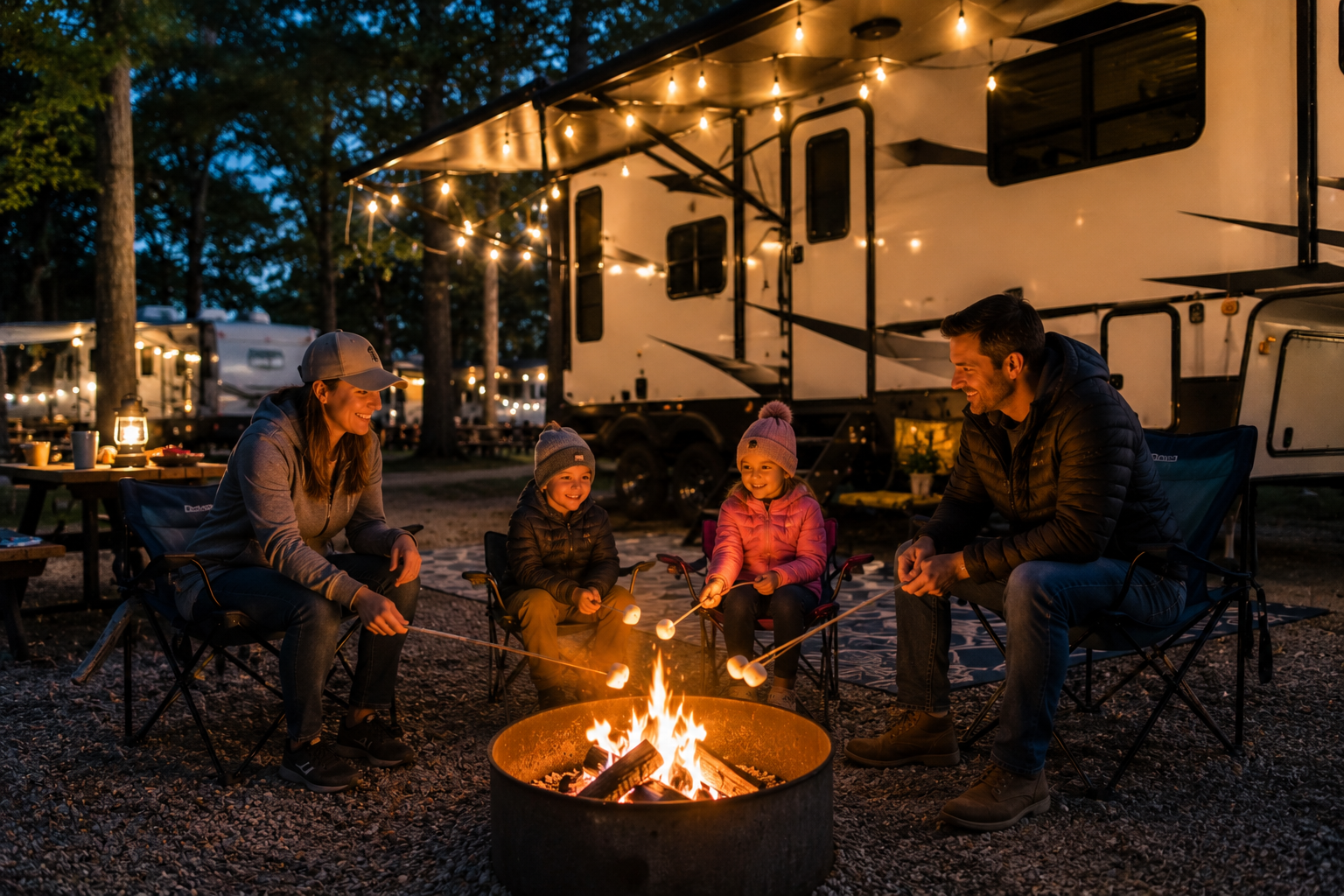
Fire pits are another factor that parents sometimes overlook until they are at the site. Portable fire rings and permanent campfire pits hold heat long after the flames are out. For families with children under five, a simple rule applied consistently — no unsupervised access to the fire ring area — prevents the majority of incidents before they happen.
Electrical hookups and utility connections at the site need attention too. Modern RV parks use covered pedestal connections, but children who are naturally drawn to anything mechanical need clear instruction to stay away from hookup equipment.
Setting Up Your Site with Safety in Mind
The way you arrange your campsite can dramatically reduce the number of times you say the word "no" in a given day — and more importantly, reduce the number of close calls.
When selecting a specific site within the campground, ask for a pull-through rather than a back-in site if possible. Pull-throughs eliminate the reversing maneuver that creates a blind spot hazard for children playing near the rig. They also tend to offer a more open layout with more visible open space around the RV.
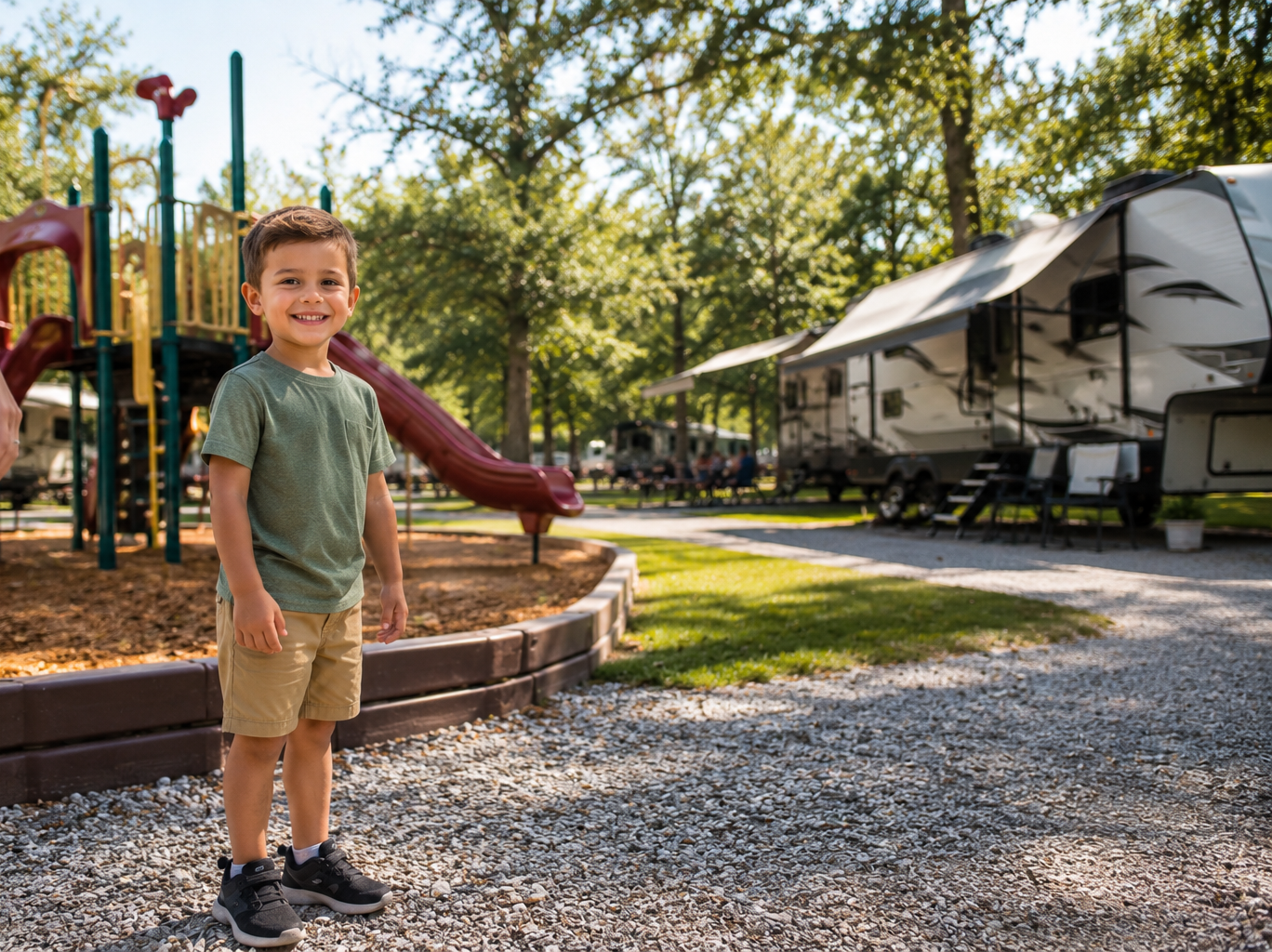
Request a site near the playground if you are traveling with toddlers or children under eight. Proximity means you can watch them play from your camp chair without needing to physically escort them every time. The closer the playground, the more easily you maintain visual supervision while also getting through your own campsite tasks.
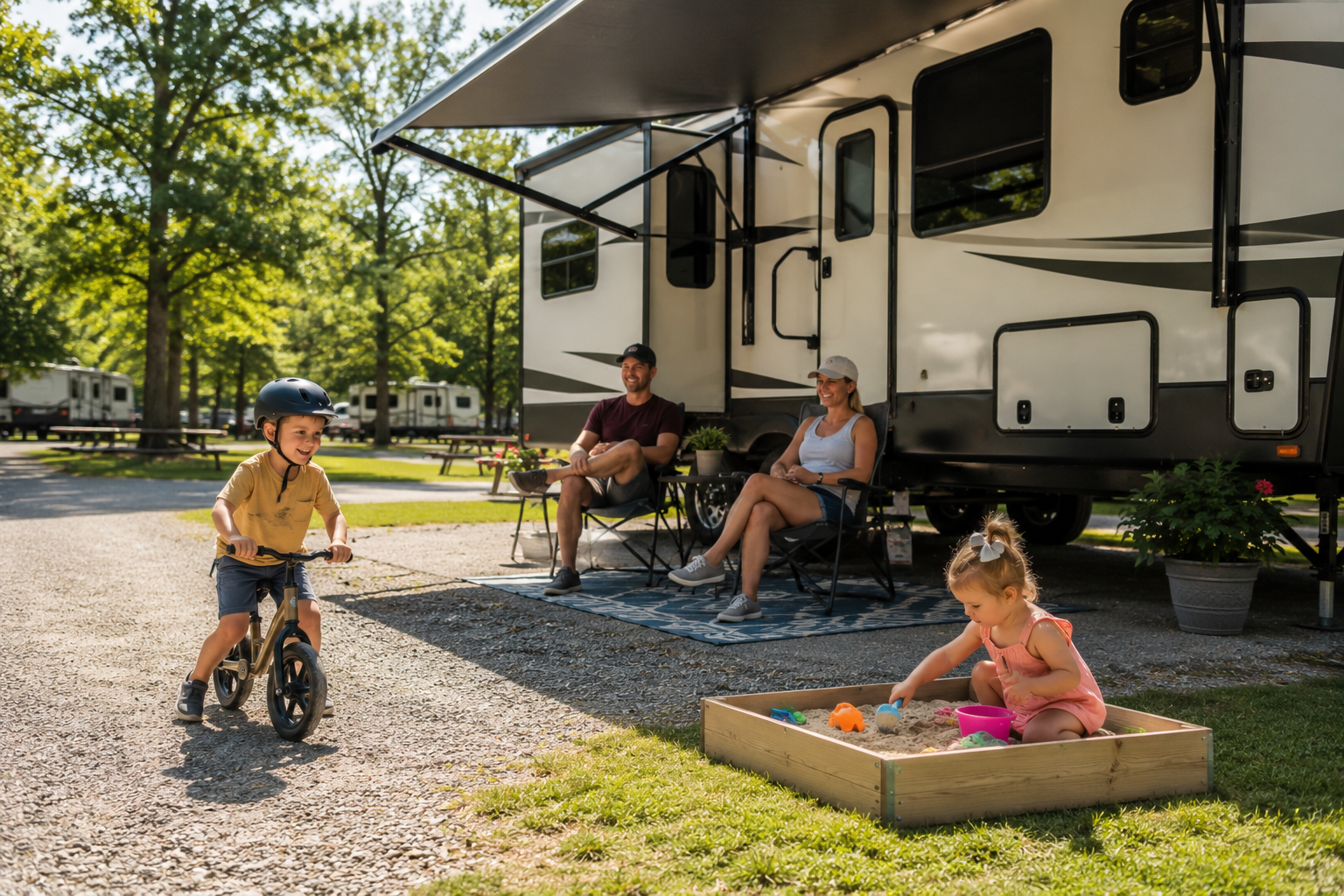
Use your RV's awning and outdoor furniture to anchor your family's activity zone. When kids have a defined, comfortable outdoor space — chairs, a small table, a rug, their outdoor toys — they are naturally less inclined to wander. The campsite becomes their territory, and they tend to stay within it.
A few practical additions that experienced RV families rely on:
A portable pop-up playard or soft perimeter fence for toddlers who have not yet mastered the concept of staying put
Walkie-talkies for children old enough to use them independently — a simple communication tool that works when cell signals do not
Glow sticks or clip-on LED lights attached to kids' belt loops or backpacks for evening visibility around the campground
A first aid kit stocked for children, including age-appropriate doses of basic medications, bandages, and emergency contact information
Teaching Small Children Campground Safety Rules
The physical environment matters, but the habits you build in your children matter more over time. Families who RV regularly report that their kids become genuinely capable and safety-aware in campground settings — but that awareness has to be built intentionally and early.
Start with two non-negotiable rules for every new campground arrival:
First, children must know the campsite number. Write it on their wrist if necessary. A child who can tell a camp host or neighboring camper their site number can be returned safely if they wander and become confused about their location.
Second, children must stop and look before crossing any internal road, the same as they would at a street crossing at home. The casual appearance of campground roads creates a false sense that the rules of road safety do not apply — they absolutely do.
Build additional rules gradually based on your child's age and demonstrated maturity. A three-year-old stays within arm's reach. A five-year-old stays within sight. A seven-year-old with good judgment can play at the nearby playground while a parent watches from the site. The progression is gradual and earned, not assumed.
Role-play scenarios before you arrive at each new campground. Ask your child what they would do if they got separated from you. Ask them which adults to approach for help — camp staff, families with young children, anyone in a campground uniform. Repeating these conversations across multiple trips makes the responses automatic.
How to Research a Campground's Safety Before You Book
The single best tool available to RV parents is other RV parents. Apps like Campendium and The Dyrt host detailed reviews from real families who describe exactly what the campground environment was like for their children — including things the official campground website would never mention.
When reading reviews, filter specifically for comments from families with young children. Look for mentions of traffic management, playground condition, pool safety, lighting quality, and the general atmosphere of the guest population. A campground full of retired couples is not unsafe, but it may not be the environment where your toddler thrives either.
Call the campground directly before booking if you have specific concerns. Ask about their policies on children, whether they have speed enforcement on internal roads, and whether there is an on-site host available overnight. A campground that handles these questions professionally and thoroughly is a campground that has thought carefully about its younger guests.
Check satellite imagery of the campground layout using Google Maps. Look for how close sites sit to roads, water features, and the campground perimeter. A visual overview before arrival helps you request the right site rather than accepting whatever is assigned.
The Right RV Makes the Campground Experience Safer
One factor that rarely appears in campground safety discussions is the RV itself. A rig that is well-suited to family life reduces the number of hazardous situations that arise at the campsite.
Fifth wheels and travel trailers with rear bunk rooms keep children's sleeping and play areas separated from the main entry and exit door of the RV, reducing the chances of small children slipping out unsupervised during setup and breakdown. Rigs with a functional outdoor kitchen or awning-mounted setup keep meal preparation in a visible outdoor space rather than pulling a parent completely inside the RV while children play unattended outside.
Carbon monoxide detectors, smoke detectors, and LP gas detectors should be tested and verified functional before every trip, not just once at the time of purchase. These are not optional safety features — they are essential ones, and they require regular attention to remain effective.
At A&L RV Sales, the team works with families across Tennessee, Georgia, Virginia, and North Carolina to match parents of young children with floor plans that reflect how families with small kids actually operate day to day. The right rig for your family is not just about space — it is about how the layout supports safety, visibility, and the kind of daily routine that keeps everyone calm and accounted for.
Explore the current inventory of family-ready fifth wheels and travel trailers across A&L RV Sales' eight locations, or speak with a team member who understands what full-time and frequent family travel actually demands.