Family RV Living: How to Make It Work on the Road
How to Live in an RV with a Family: A Complete, Honest Guide—Which
Living in an RV with your family sounds like a dream to some and a logistics nightmare to others. The truth sits somewhere in the middle — and once you understand the realities, most families who take the plunge never look back. This guide walks you through everything that actually matters: picking the right rig, managing money on the road, keeping kids educated, and building a routine that doesn't drive everyone crazy by week three.
Choosing the Right RV Before Anything Else
The single biggest mistake families make is underestimating how much floor plan matters. Square footage alone doesn't tell the full story. A 38-foot fifth wheel with a poorly designed layout will feel more cramped than a 34-foot model with smart room separation and multiple slide-outs.
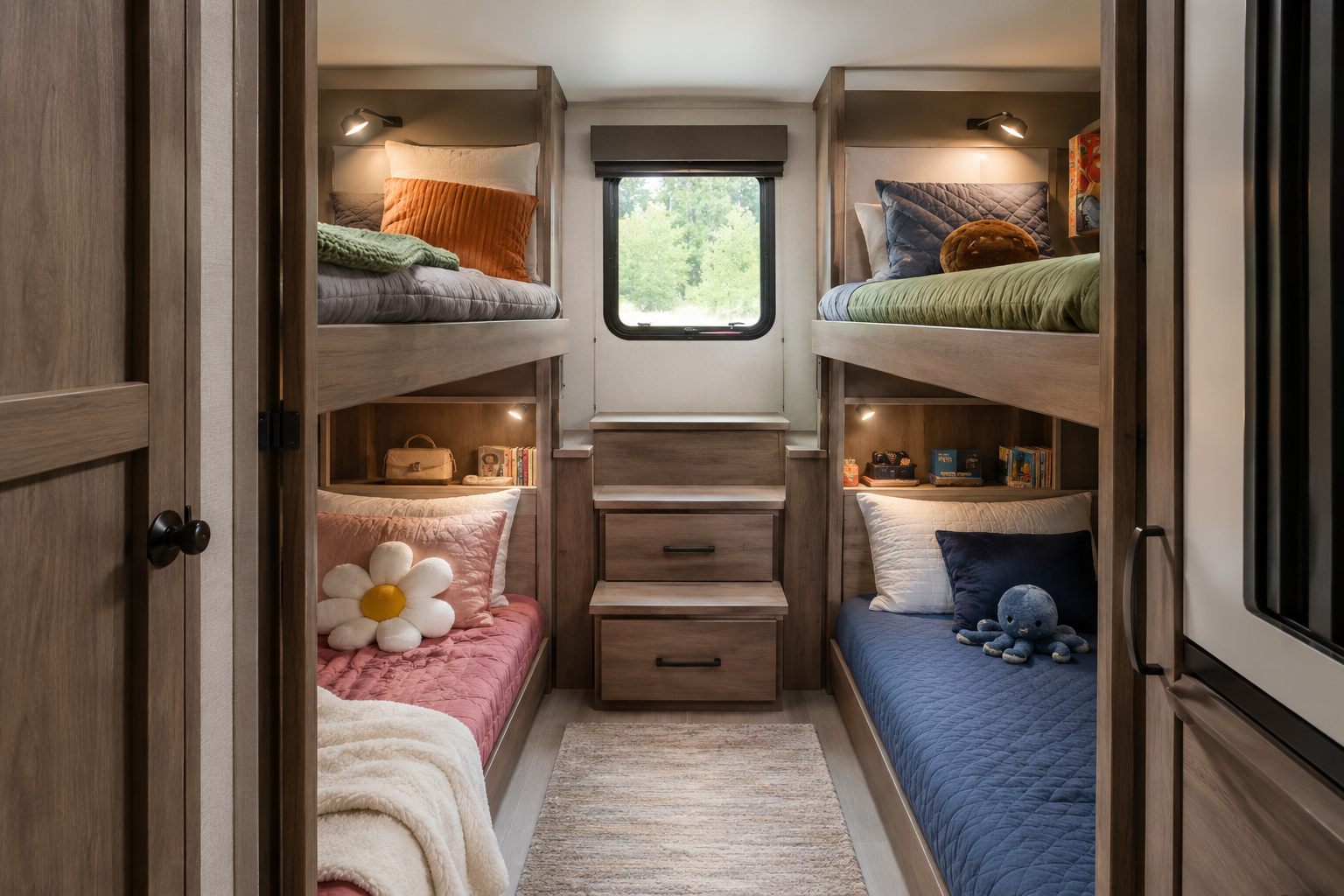
For a family of four, a rear bunk room is non-negotiable. This creates a physical divide between where the adults sleep and where the kids sleep — and that divide does more for family harmony than any other feature. Look for floor plans where the bunk room has its own dedicated entry, ideally with a small door rather than just a curtain.
Beyond sleeping arrangements, these features make a real difference in daily life:
A full-size residential refrigerator rather than an RV-style compact unit
A genuine kitchen oven, not just a microwave-convection combo
At least one and a half bathrooms to eliminate the morning bottleneck
A dinette or fixed desk area that can serve as a schoolwork and remote work station
A large awning with outdoor space to functionally extend your living area
Fifth Wheel or Travel Trailer — Which One Is Right for Your Family?
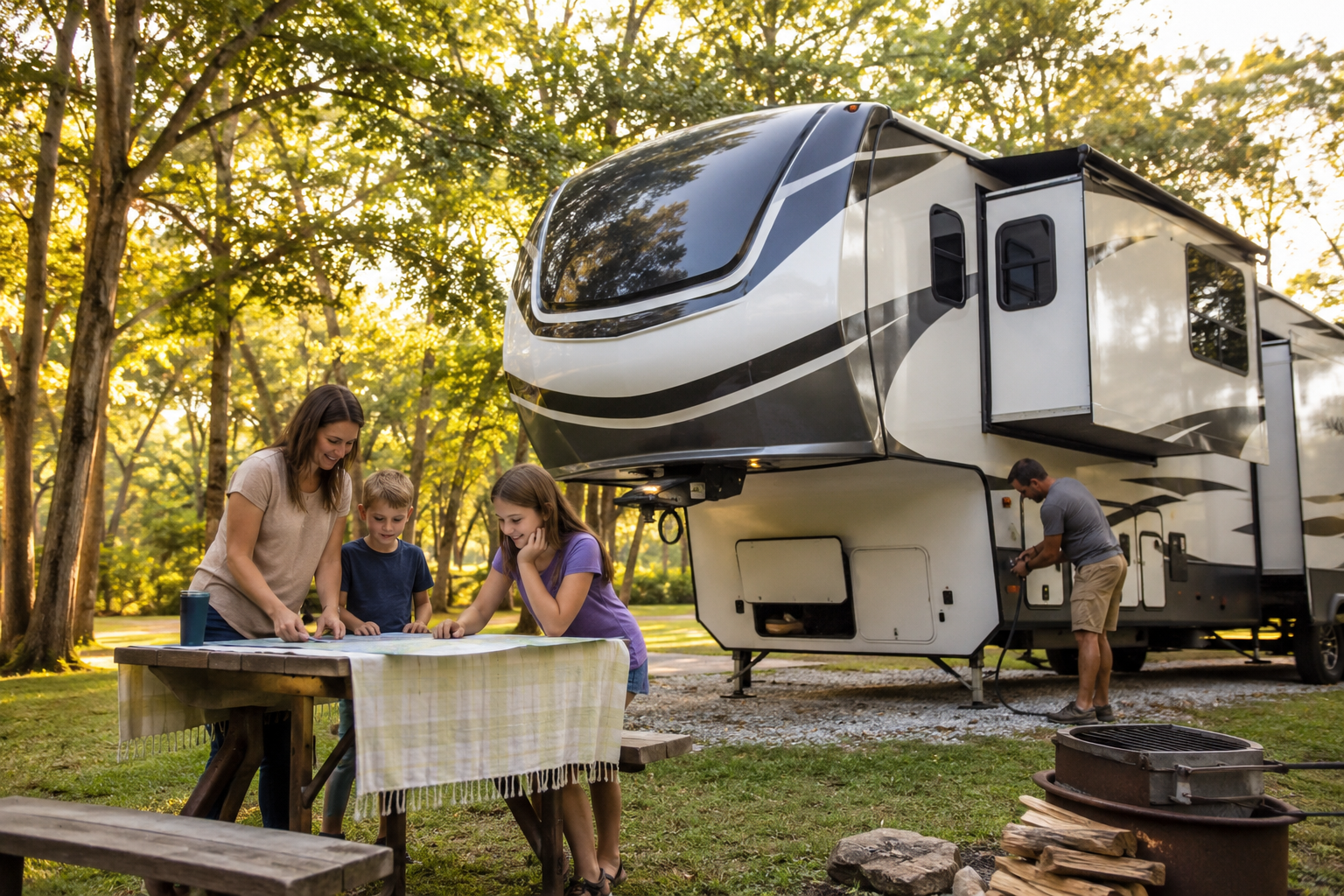
Fifth wheels are the overwhelming preference among families who commit to full-time RV living. The bi-level construction gives you natural zones — the master bedroom up front sits physically above and separate from the main living area, while kids settle into the rear bunk room. The build quality on fifth wheels is also generally more robust, which matters when your RV is your permanent home rather than an occasional weekend rig.
Travel trailers, on the other hand, cost less upfront and tow behind a standard half-ton or three-quarter-ton pickup. If your family wants to test the full-time lifestyle for six months before fully committing, a well-chosen travel trailer is a smart starting point. Models from brands like Dutchmen and Forest River offer surprisingly livable floor plans at accessible price points.
A&L RV Sales carries an extensive range of both fifth wheels and travel trailers across locations in Tennessee, Georgia, Virginia, and North Carolina — with staff who work with full-time families regularly and understand exactly what floor plans hold up to real daily use.
What Full-Time RV Living Actually Costs
Nobody talks about this honestly enough. The cost of living in an RV full-time with a family varies enormously based on how fast you travel, where you park, and how new your rig is.
A reasonable baseline for a family of four runs between $2,500 and $4,500 per month. Here is where that money typically goes:
Campground fees are usually the largest line item, ranging from $600 to $1,500 depending on whether you stay at full-hookup RV resorts, state parks, or mix in free boondocking nights
Fuel costs depend almost entirely on how frequently you move — families who pull up stakes every two or three days spend dramatically more than those who park for two or three weeks at a time
Groceries run similarly to a traditional household, typically $500 to $900 per month, though cooking in a smaller kitchen encourages simpler and often cheaper meals
RV insurance for a full-timer policy runs $100 to $200 monthly
Internet and phone connectivity — usually two cellular plans with data plus a signal booster — adds another $150 to $250 each month
A maintenance and repair fund of at least $100 to $300 monthly is not optional — it is essential
The most effective cost-cutting strategy is also the simplest: slow down. Families who move less frequently save on fuel, qualify for weekly and monthly campground rates, and experience each location more deeply. Moving every night is a romantic idea that gets expensive and exhausting within weeks.
Keeping Kids Educated on the Road
Schooling is the concern that stops more families from making the move than any other. It shouldn't. Hundreds of thousands of families homeschool their children successfully, and RV families have access to the same resources — plus a classroom that spans the entire country.
The most common approach is a structured homeschool curriculum delivered online. Platforms like Time4Learning and Connections Academy provide grade-appropriate coursework that kids complete on their own schedule, which fits perfectly into an RV lifestyle where mornings might be spent hiking and afternoons at the dinette working through lessons.
Virtual public school is another option. It's free and provides certified teachers and official transcripts, but it typically requires enrollment through a specific state and imposes a more rigid daily schedule that can conflict with frequent travel.
Some families lean into experiential and project-based learning entirely — letting geography, history, science, and math emerge naturally from the places they visit and the problems they solve on the road. A family touring the national parks of the Southwest covers geology, ecology, and Native American history in ways no textbook replicates. A child who helps plan a route, manages a campsite budget, and navigates a new city builds real-world skills that have lifelong value.
Whatever approach you choose, a dedicated workspace inside your RV matters. A fixed dinette seat with good lighting and a flat surface makes the difference between productive school days and distracted, frustrated ones.
Building a Routine That Actually Holds Up
Small spaces amplify everything — good moods and bad ones. Families who thrive in RVs do so because they treat routine not as a limitation but as a foundation. When everyone knows what happens in the morning, who has quiet time when, and what the end-of-day reset looks like, the shared space stops feeling small.
Organization is the mechanical side of this. Every single item in an RV needs a home. Clutter accumulates faster in 400 square feet than anywhere else, and once it starts, it spirals quickly. The most successful RV families operate by one firm rule: if something new comes in, something old goes out.
A few practical habits that make a measurable difference:
Each family member owns one personal storage bin — everything they want to keep must fit inside it
Vertical storage through wall-mounted hooks, over-door organizers, and under-bed containers recovers space that floor storage wastes
Outdoor gear, sports equipment, and bulky seasonal items stay in a cargo carrier or external storage box mounted to the hitch, not inside the living space
A short 10-minute tidy at the end of each evening keeps the next morning from starting in chaos
Personal space matters even in tight quarters. Protecting small pockets of solitude — a parent's coffee ritual before anyone else wakes up, a child's independent reading window in their bunk — prevents the kind of low-grade friction that builds over weeks of constant togetherness.
The Community You Don't Expect
Most families enter RV life worried about isolation. Most leave that worry behind within the first month. Campgrounds and RV parks have their own social ecosystems, and the full-time RV community is genuinely one of the friendliest you'll encounter anywhere.
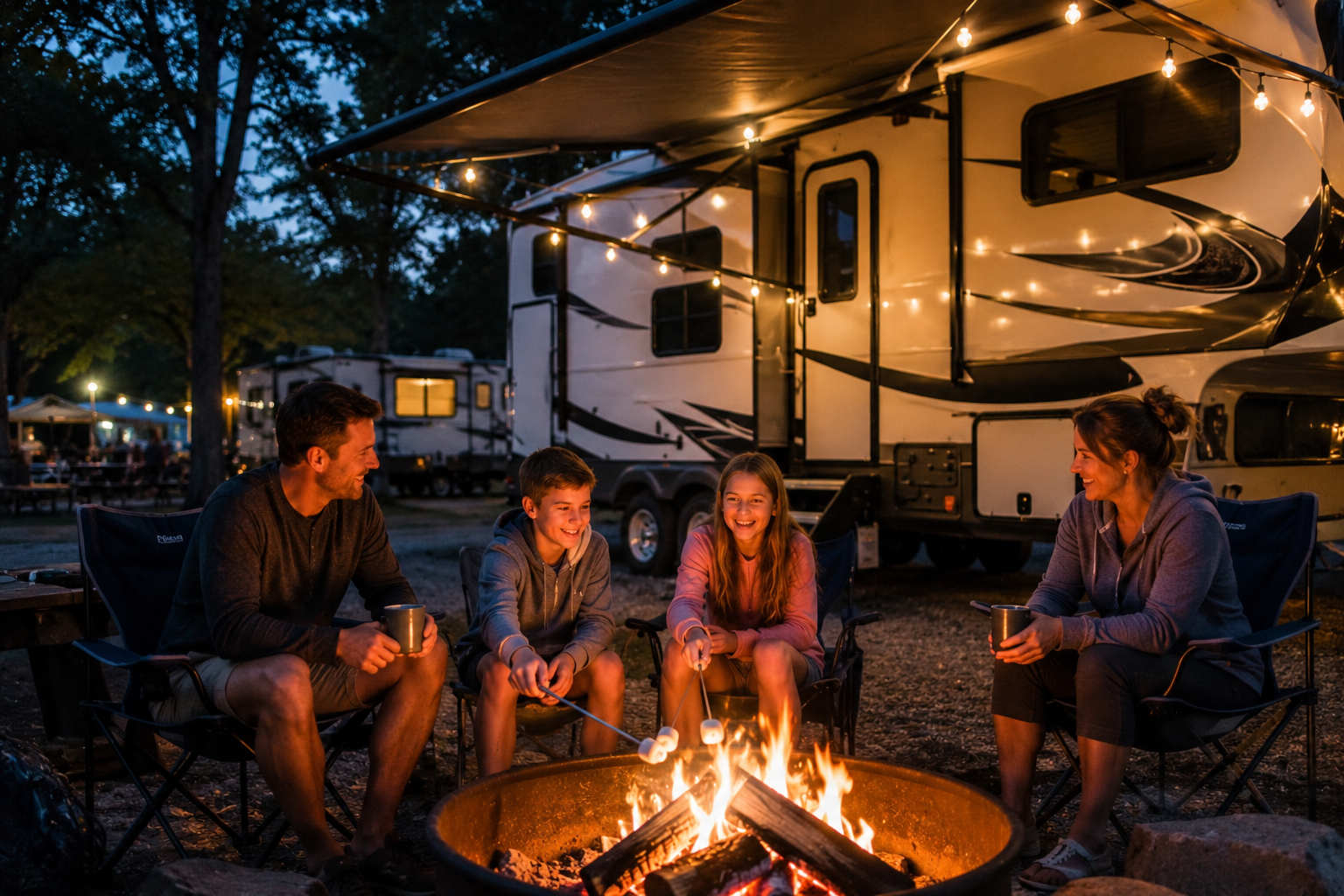
Kids connect naturally at campfire circles and shared playgrounds. Adults swap campground recommendations, repair tips, and local knowledge freely. There's a shared understanding among full-timers that everyone is figuring it out as they go, which creates unusual warmth between strangers.
Apps like Campendium, The Dyrt, and RVillage make it easy to find family-friendly campgrounds, read honest reviews, and connect with other families before you even arrive at a new location. Online communities, particularly on Facebook and Reddit, provide real-time support when something mechanical goes wrong on a Sunday evening far from a dealership — and at some point, it will.
Is This Lifestyle Right for Your Family?
Full-time RV living with a family works best when a few conditions align. You need income that is either remote, freelance, or flexible enough to accommodate movement. You need kids who can adapt to new environments, new peers, and less physical space than they're used to. And you need honest conversations about what each family member is giving up and gaining.
The families who struggle most are those who expected the lifestyle to be a permanent vacation. It isn't. It's a different way of living with its own rhythms, challenges, and rewards. The families who thrive are those who approached it as a deliberate choice rather than an escape — and who invested time upfront in finding the right RV for how they actually live.
That last part is where A&L RV Sales comes in. With eight locations across Tennessee, Georgia, Virginia, and North Carolina and a team experienced with full-time family buyers, finding the right fifth wheel or travel trailer for your specific situation is a straightforward conversation — not a guessing game.