
How to Find Your Truck's Real Towing Capacity
If your truck brochure says it can tow 12,000 pounds, does that mean you can safely hook up any trailer under 12,000 pounds?
Usually, no.
The advertised maximum towing capacity is often based on a specific truck configuration under controlled assumptions. Your truck's real towing capacity depends on its exact engine, axle ratio, cab, drivetrain, payload rating, passengers, cargo, hitch equipment, and the actual loaded weight of the RV.
That is why two trucks with the same badge on the tailgate can have very different towing limits.
A&L RV Sales offers an online Tow Vehicle Guide that allows shoppers to select their vehicle's year, make, model, and trim to compare its towing capability with appropriate RVs. A&L also currently carries more than 500 travel trailers and more than 230 fifth wheels, so understanding your truck's actual limits before shopping can narrow the inventory significantly.
Here is how to work out what your truck can realistically tow.
Start With Your Exact Truck, Not the Advertised Maximum
The first mistake many RV buyers make is searching online for something like:
"F-150 towing capacity"
or
"Silverado 1500 max towing."
Those numbers can be useful for general comparison, but they may not apply to your truck.
Towing ratings can change based on:
Engine
Transmission
Axle ratio
Two-wheel drive or four-wheel drive
Regular, extended, or crew cab
Bed length
Factory towing package
Installed options
Wheel and tire configuration
Ford specifically notes that maximum towing varies with vehicle configuration, cargo, accessories, and passengers. Chevrolet likewise explains that drivetrain, suspension, chassis load capacity, wheelbase, and other factors affect towing ratings.
That means the safest starting point is always the information for your specific truck, not the maximum rating advertised for the model line.
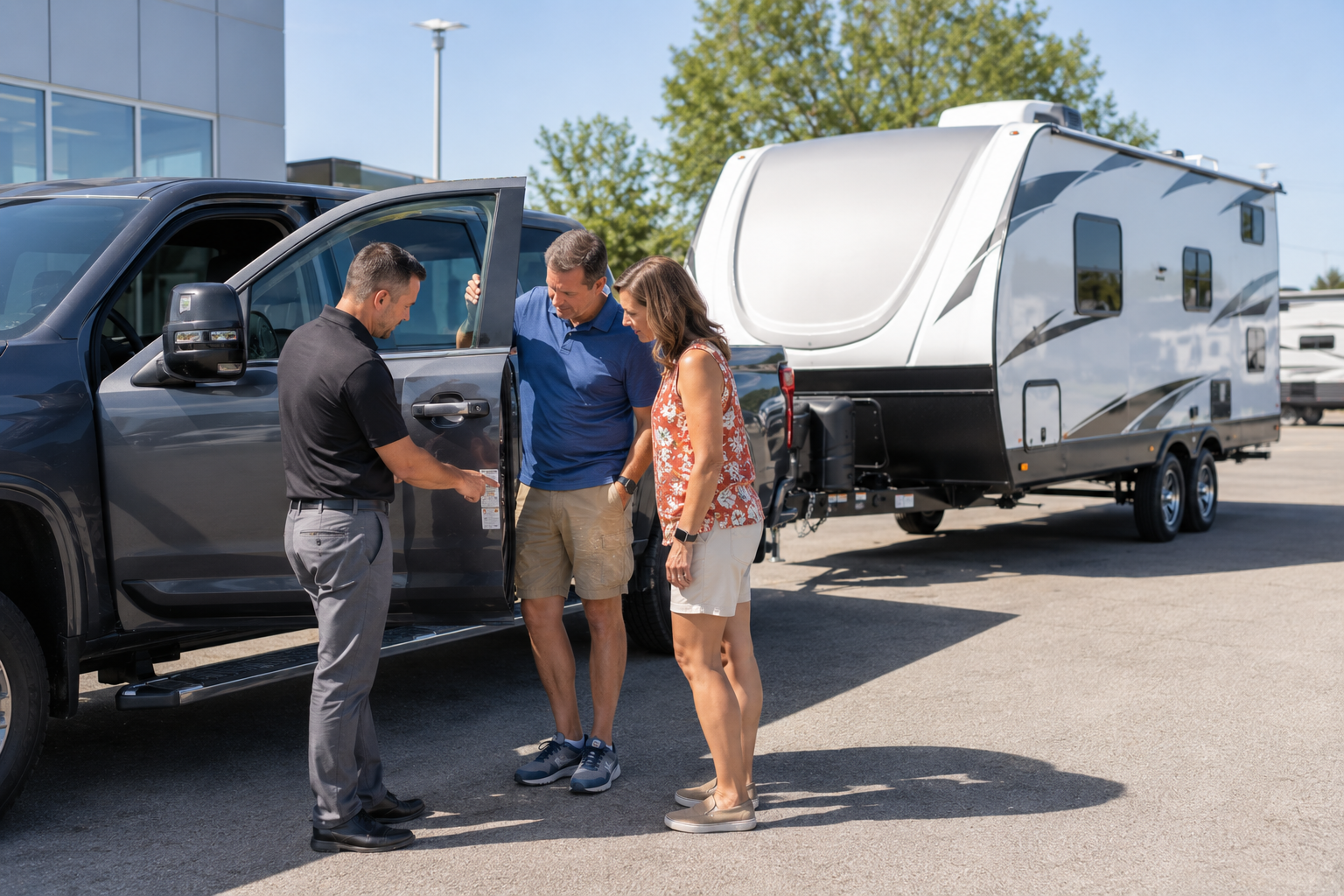
Step 1: Find the Driver-Door Labels
Open the driver's door and look at the certification and tire-loading labels on the door or door jamb.
Depending on the manufacturer, these labels may provide information such as:
GVWR
GAWR
Payload or occupant-and-cargo capacity
Tire ratings
Vehicle-specific trailering information
Some newer trucks provide especially detailed towing labels.
For example, Chevrolet states that certain trucks include a Trailering Information Label showing vehicle-specific information such as GVWR, GCWR, rear axle rating, maximum payload, maximum tongue weight, and curb weight.
Take a clear photo of these labels before you begin shopping for an RV.
You will use those numbers repeatedly.
Step 2: Understand Payload Capacity
For many RV buyers, payload becomes the limiting factor before maximum towing capacity does.
Payload is the amount of weight your truck is designed to carry.
That includes things such as:
Driver
Passengers
Cargo
Tools
Coolers
Gear in the truck bed
Aftermarket accessories
Hitch equipment
Travel trailer tongue weight
Fifth-wheel pin weight
Ford defines payload as the allowable combined weight of passengers and cargo and specifically notes that trailer tongue load or fifth-wheel king pin weight contributes to cargo load.
Imagine your truck has 1,700 pounds of available payload.
If your family, camping gear, and hitch equipment account for 700 pounds, you only have roughly 1,000 pounds of payload remaining before considering the trailer's tongue weight.
That can quickly change which RVs are realistic.
Step 3: Understand GVWR
GVWR stands for Gross Vehicle Weight Rating.
This is the maximum allowable weight of the fully loaded truck.
It includes the truck itself plus passengers, cargo, hitch equipment, and the weight transferred to the truck by the trailer.
You should never load the truck beyond its GVWR.
Ford describes GVWR as the maximum allowable weight of the fully loaded vehicle, while Chevrolet states that adding trailer hitch weight must not cause the truck to exceed its GVWR or rear axle rating.
This is another reason maximum tow rating alone cannot determine whether an RV is suitable.
Step 4: Check Your GCWR
GCWR means Gross Combined Weight Rating.
This is the maximum allowable combined weight of your loaded truck and loaded trailer.
In simple terms, your entire towing combination must stay within this rating.
That includes:
Truck
Passengers
Truck cargo
Trailer
Trailer cargo
Camping equipment
Chevrolet defines GCWR as the total allowable weight of the fully loaded vehicle and trailer together.
One useful way to estimate the capacity remaining for the trailer is to subtract the truck's actual loaded weight from the GCWR.
For example:
If your GCWR is 18,000 pounds and your truck weighs 7,000 pounds loaded for the trip, you theoretically have 11,000 pounds remaining within the combined-weight limit.
But that does not automatically mean you can tow an 11,000-pound trailer.
You must still stay within the truck's published maximum trailer rating, payload limit, axle ratings, hitch rating, and all other manufacturer limits.
Step 5: Calculate Realistic Tongue Weight
Travel trailer tongue weight is the downward force placed on the hitch.
A common target for conventional travel trailers is approximately 10% to 15% of the loaded trailer weight. Chevrolet uses this same range in its current trailering guidance.
Suppose your travel trailer weighs 7,000 pounds when loaded.
At 10% tongue weight, that would be about 700 pounds.
At 15%, it would be about 1,050 pounds.
That entire tongue load affects your truck's payload.
This is why a truck may technically have enough maximum towing capacity for a trailer but not enough payload once passengers and gear are added.
What About Fifth-Wheel Pin Weight?
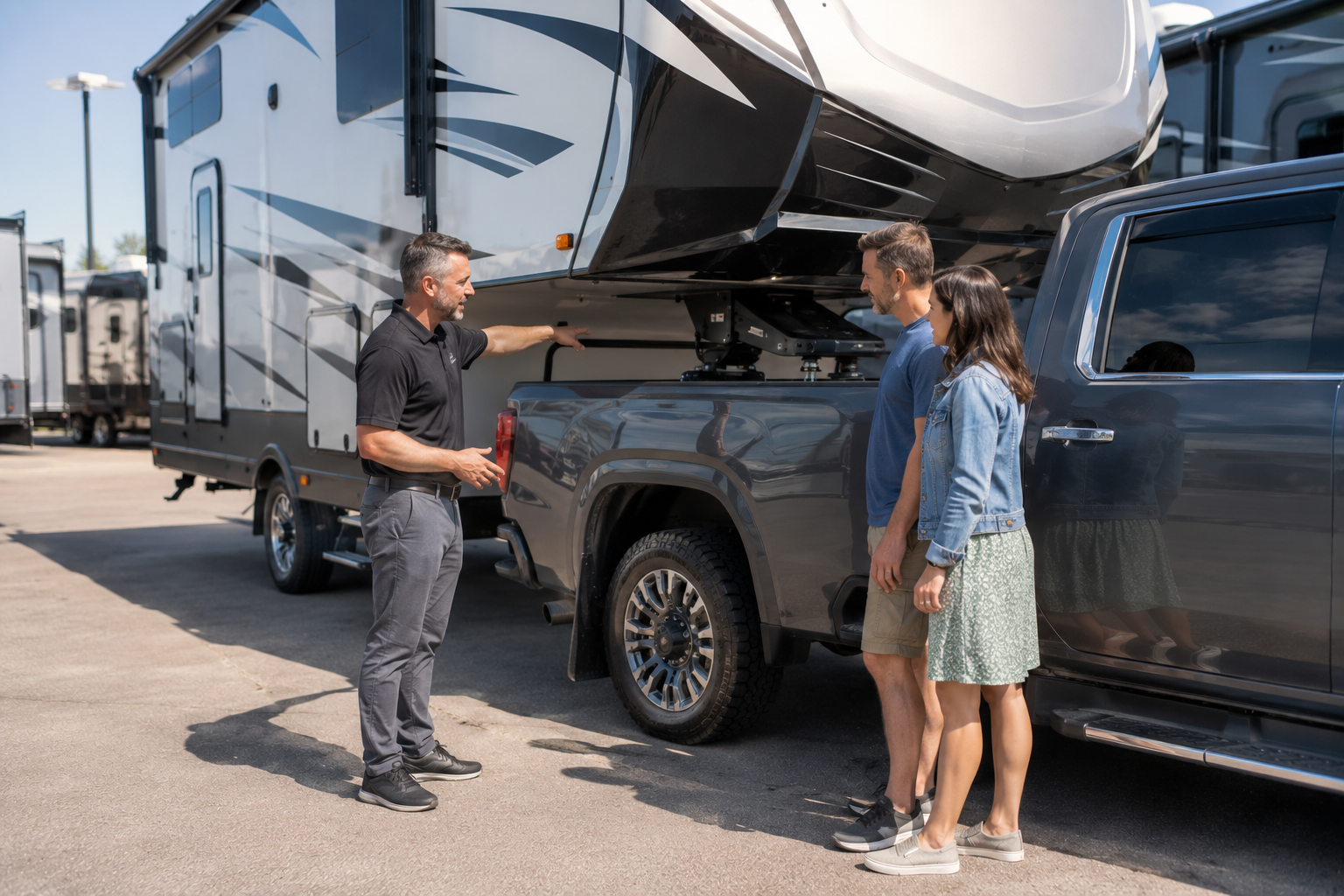
Fifth wheels transfer considerably more weight onto the truck.
A&L RV Sales' towing guide explains that fifth-wheel pin weight is commonly around 15% to 25% of the trailer's weight.
So a 12,000-pound loaded fifth wheel could place approximately 1,800 to 3,000 pounds over the truck's rear axle, depending on the trailer and loading.
That is why payload and rear axle capacity are especially important when shopping for a fifth wheel.
Step 6: Stop Using Dry Weight as Your Main Number
The dry weight shown on an RV listing is useful, but it is not necessarily what the trailer will weigh when you go camping.
Once you add:
Batteries
Propane
Fresh water
Food
Clothing
Camping chairs
Kitchen equipment
Outdoor gear
Tools
the trailer can become substantially heavier.
A&L RV Sales' own towing content emphasizes looking at actual RV weight ratings, including GVWR and loaded weight, rather than relying only on an empty trailer number.
When evaluating an RV, pay close attention to its GVWR, which represents the maximum allowable loaded weight of the trailer.
You may not actually load the trailer all the way to GVWR, but using that figure during the early shopping stage can provide a more conservative comparison.
Step 7: Subtract Your Real Passengers and Cargo
This is where theoretical towing capacity becomes real-world towing capacity.
Before selecting your RV, estimate what will actually be inside your truck during a normal camping trip.
For example:
Driver: 190 pounds
Passenger: 150 pounds
Two children: 180 pounds combined
Cooler and bags: 100 pounds
Tools and gear: 100 pounds
Hitch equipment: 100 pounds
That is already 820 pounds before tongue weight is added.
If the payload label allows 1,650 pounds, you would have roughly 830 pounds remaining for trailer tongue weight before reaching that payload figure.
A large trailer with 1,000 pounds of tongue weight would therefore be a poor match even if its total weight remained below the truck's advertised towing capacity.
Step 8: Check Rear Axle Capacity
The rear axle often carries a significant share of the additional weight when towing.
That is particularly important with fifth wheels because their pin weight sits in the truck bed.
Look for the rear Gross Axle Weight Rating, often abbreviated RGAWR.
Chevrolet specifically warns that trailer hitch weight must not cause the vehicle to exceed the rear axle rating.
The most accurate way to understand your actual axle loading is to weigh the truck at a certified vehicle scale in its normal travel configuration.
Step 9: Check the Hitch Rating
Do not forget the receiver or fifth-wheel hitch itself.
Every towing component has limits.
Your truck may be capable of towing a particular trailer while the installed hitch is rated for less weight.
Check:
Maximum trailer rating
Maximum tongue or pin weight
Weight-carrying rating
Weight-distribution rating where applicable
The safe limit is determined by the lowest-rated component in the towing system.
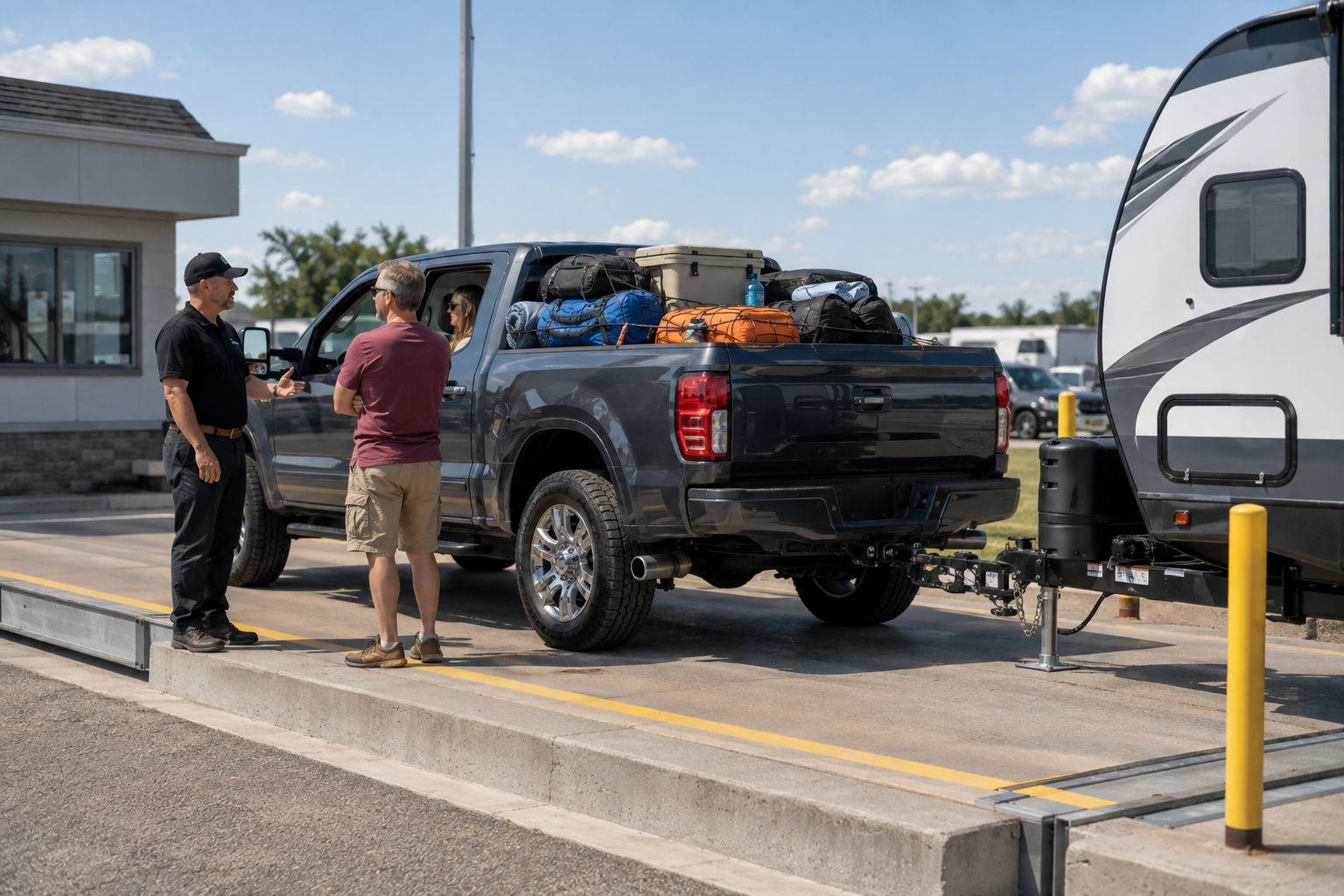
Step 10: Weigh the Truck for the Most Accurate Answer
If you already own the truck, one of the best ways to move from estimates to real numbers is to weigh it.
Load the truck as you normally would for camping.
Bring the passengers, gear, hitch equipment, and normal cargo.
Then use a certified vehicle scale to determine the truck's actual loaded weight.
Once you know the real number, you can compare it against:
GVWR
Front and rear axle ratings
GCWR
Payload limits
That gives you a much more realistic towing picture than an online maximum-capacity chart.
A Simple Example of Real Towing Capacity
Suppose you own a pickup with:
10,000-pound maximum trailer rating
1,700-pound payload capacity
16,000-pound GCWR
After adding passengers, luggage, tools, and hitch equipment, you have 900 pounds of payload remaining.
You find a travel trailer with a loaded weight of 7,500 pounds.
If the trailer creates approximately 12% tongue weight, that is about 900 pounds on the hitch.
In this example, the setup may be right at the truck's available payload limit even though the trailer weighs 2,500 pounds less than the advertised maximum tow rating.
That is exactly why "my truck tows 10,000 pounds" is not enough information.
Should You Use the 80% Towing Rule?
You may hear RV owners recommend staying below approximately 80% of the truck's maximum towing capacity.
A&L RV Sales discusses this as a practical buffer for conditions such as hills and demanding travel.
However, this is a rule of thumb, not a substitute for manufacturer ratings.
The important requirement is that you remain below every applicable weight rating.
Leaving extra capacity can make towing more comfortable, but simply staying under 80% does not make an overloaded payload or axle safe.
Why Your Truck's Configuration Matters So Much
Ram's current towing specifications show how dramatically capacity can change even within one truck line.
Depending on engine, axle ratio, drivetrain, and cab configuration, 2026 Ram 1500 towing and payload ratings vary significantly.
That same principle applies across many pickup manufacturers.
Never assume that your friend's truck can tow a trailer safely just because yours has the same model badge.
Use A&L RV Sales' Tow Vehicle Guide
Once you know your truck's year, make, model, and trim, A&L RV Sales' Tow Vehicle Guide can help narrow your RV search.
The tool is designed to show vehicle towing information and help shoppers identify RVs that may fit their tow vehicle. A&L clearly states that the tool is for reference and that buyers should verify specifications with the vehicle manufacturer.
That disclaimer is important.
A towing calculator is a great filtering tool, but your owner's manual, certification labels, manufacturer towing guide, and actual loaded weights remain the final authority.
Final Checklist Before Buying a Towable RV
Before purchasing a travel trailer or fifth wheel, confirm:
Exact maximum trailer rating
Payload capacity
GVWR
GCWR
Front and rear axle ratings
Hitch rating
Estimated loaded trailer weight
Realistic tongue or pin weight
Passenger weight
Truck cargo weight
Trailer cargo
Then make sure none of those limits are exceeded.
A&L RV Sales currently carries hundreds of travel trailers and fifth wheels across eight locations in Tennessee, Georgia, Virginia, and North Carolina, giving shoppers a wide range of RV weights and floorplans to compare once their truck's real limits are known.
Frequently Asked Questions
Where Do I Find My Truck's Towing Capacity?
Start with the owner's manual, manufacturer towing guide, vehicle-specific door labels, and any factory trailering information label.
Do not rely solely on a generic towing-capacity search online.
Is Payload More Important Than Towing Capacity?
Both matter, but payload frequently becomes the limiting factor when towing an RV because tongue weight or fifth-wheel pin weight counts against the truck's carrying capacity.
Does Tongue Weight Count Against Payload?
Yes.
Ford specifically includes trailer tongue load and fifth-wheel king pin weight as part of the load carried by the tow vehicle.
Should I Use RV Dry Weight or GVWR?
Dry weight is useful for comparison, but GVWR provides a more conservative figure for initial tow-vehicle matching because it accounts for the trailer's maximum allowable loaded weight.
How Much Tongue Weight Should a Travel Trailer Have?
Conventional trailers are commonly set up with approximately 10% to 15% of their loaded weight on the tongue.
Can I Increase My Truck's Towing Capacity With Suspension Upgrades?
Aftermarket suspension components may change ride characteristics, but they do not automatically increase the manufacturer's GVWR, GCWR, axle ratings, payload rating, or maximum trailer rating.
Always follow the truck manufacturer's ratings.