New vs Used Fifth Wheel: Which Is the Smarter Buy?
When you start shopping for a fifth wheel, one of the first decisions is whether to buy new or used.
A new fifth wheel gives you the latest floorplans, untouched interiors, current technology, and manufacturer-backed coverage. A used fifth wheel can lower the upfront cost and may let you move into a higher-end model than your budget would allow if you bought new.
Neither option is automatically smarter.
The better choice depends on your budget, how long you expect to own the RV, how comfortable you are evaluating a pre-owned unit, and which features matter most to your family.
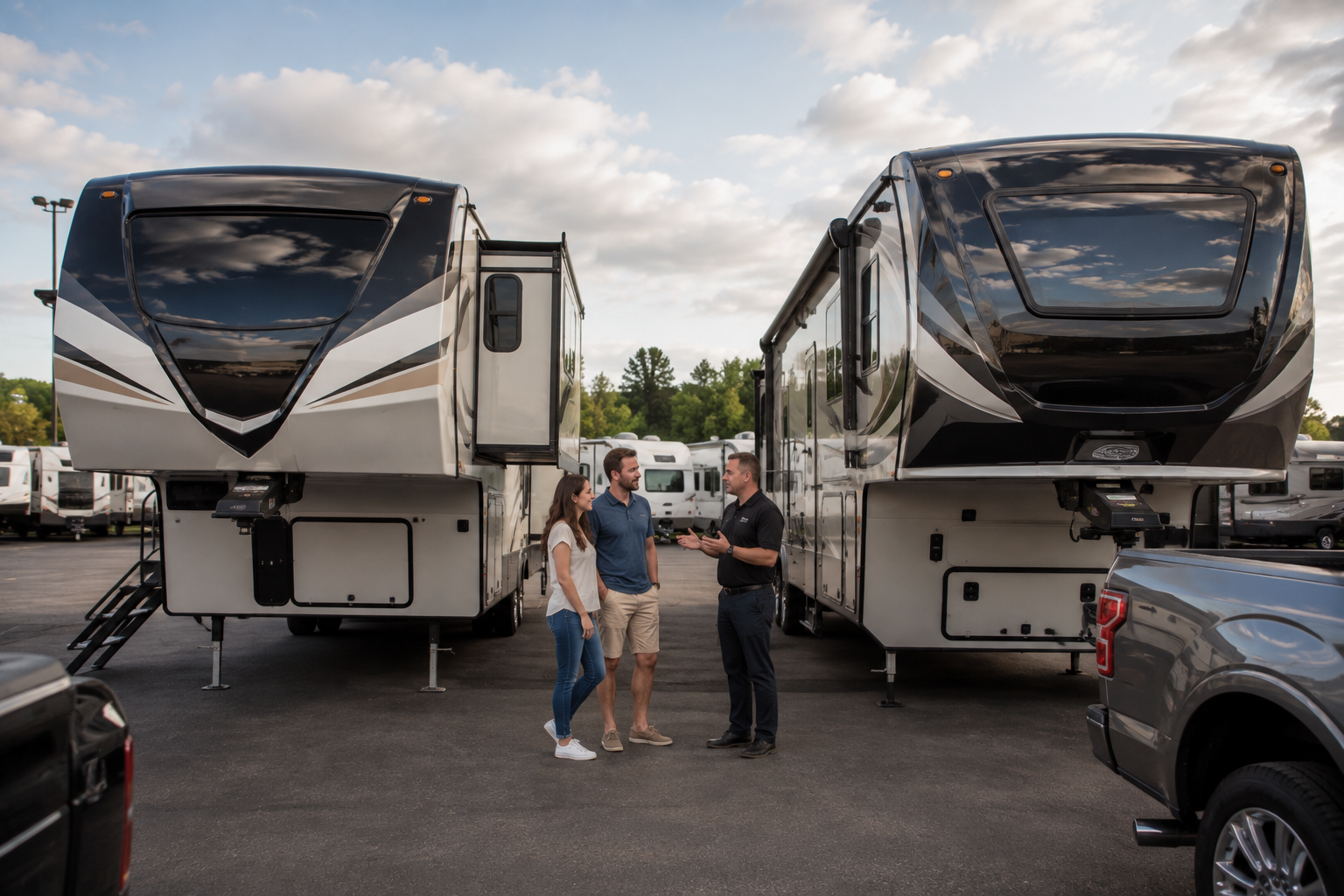
A&L RV Sales currently lists about 239 fifth wheels, including dozens of pre-owned units across its eight locations in Tennessee, Georgia, North Carolina, and Virginia. That inventory depth gives shoppers the opportunity to compare new and used fifth wheels across different brands, ages, sizes, and price points.
When Does Buying a New Fifth Wheel Make Sense?
A new fifth wheel is often the better choice for buyers who value predictability.
You know the ownership history because there is not one.
There should be no previous owner's modifications, neglected roof seals, questionable plumbing repairs, worn furniture, or hidden maintenance history to investigate.
That peace of mind can be especially valuable for first-time fifth-wheel owners.
You Get the Latest Floorplans and Features
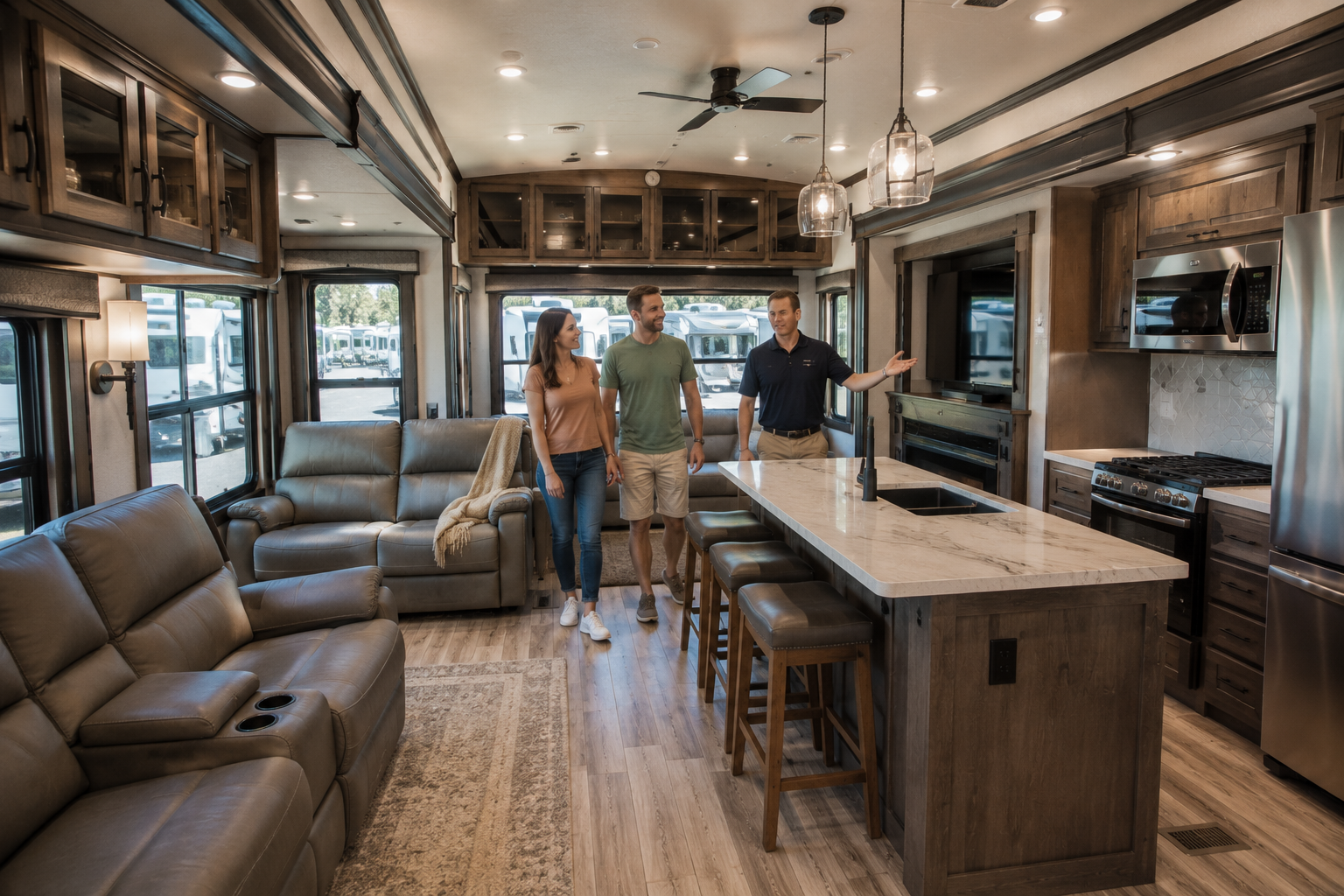
RV manufacturers regularly update floorplans, storage solutions, appliances, electronics, climate-control systems, and interior design.
Buying new gives you access to the newest versions.
That can matter if you are looking for features such as:
Residential-style kitchens
Large pantries
King-bed layouts
Rear living rooms
Bunkhouses
Front living rooms
Solar equipment
Improved entertainment systems
Multiple bathrooms
Larger refrigerators
Better workspace for remote work
If you have a very specific floorplan in mind, new inventory can provide more choices than the used market.
New Fifth Wheels Offer More Warranty Protection
Warranty coverage is one of the strongest reasons to consider buying new.
New RVs typically include manufacturer warranty protection, although coverage periods, exclusions, and requirements vary by brand.
A&L RV Sales also advertises Warranty Forever on qualifying new inventory, including many fifth wheels shown across the site.
Warranty coverage does not eliminate maintenance, but it can reduce uncertainty during the early years of ownership.
Always read the actual warranty terms before purchasing rather than assuming every component is covered.
Financing May Be Easier on Newer RVs
Lenders often consider factors such as RV age, price, credit profile, down payment, and loan term when evaluating RV financing.
New fifth wheels may qualify for longer financing terms than significantly older used units, depending on the lender.
That can make a higher purchase price more manageable monthly.
However, a lower monthly payment does not automatically mean the new fifth wheel is less expensive overall.
Always compare:
Down payment
Interest rate
Loan term
Monthly payment
Total amount financed
Total interest paid
The smartest financing decision is based on the complete cost, not just the monthly number.
What Are the Downsides of Buying New?
The biggest disadvantage is usually price.
A brand-new fifth wheel can cost substantially more than a comparable model that is several years old.
New RVs also experience depreciation.
That means the difference between what you paid and what the RV may be worth later can be greater during the earlier ownership years.
If you expect to trade again relatively quickly, depreciation deserves serious consideration.
When Is a Used Fifth Wheel the Smarter Buy?
For value-focused shoppers, used fifth wheels can be extremely attractive.
A pre-owned RV lets someone else absorb part of the initial depreciation while you receive many of the same living-space benefits.
A&L RV Sales currently lists 37 used fifth wheels, ranging from older budget-friendly models to newer premium units from brands such as Grand Design, Jayco, Keystone, Forest River, and Brinkley.
That variety can make the used market particularly useful if your goal is to maximize RV quality within a fixed budget.
Used Fifth Wheels Can Deliver More RV for the Money
Suppose your budget is $40,000.
In the new market, that might limit you to specific floorplans or product tiers.
On the used market, the same budget could potentially open the door to a larger or more premium fifth wheel that originally sold for considerably more.
For example, A&L's current used fifth-wheel inventory includes models such as a 2017 Grand Design Reflection, 2023 Jayco Eagle HT, 2023 Keystone Arcadia, 2022 Forest River Flagstaff Super Lite, and 2020 Keystone Montana High Country.
For shoppers who care more about build quality, floorplan, and features than having the newest model year, that can represent strong value.
Used RVs Have Already Taken Some Depreciation
A used fifth wheel has already gone through part of its initial depreciation cycle.
That can work in your favor if you intend to own the RV for several years and eventually resell or trade it.
You may still lose value over time, but your starting purchase price is usually lower than it would have been when that same RV was new.
This is one reason a well-maintained two- to five-year-old fifth wheel can be a compelling middle ground.
It may still have modern styling and technology without carrying the full new-unit price.
A Used Fifth Wheel May Have Proven Its Reliability
A new RV is unused, but that does not automatically mean every adjustment has already been sorted out.
A well-maintained used RV may have already had minor factory issues, adjustments, and early repairs addressed by the previous owner.
The key phrase is well maintained.
A used RV that has been neglected can quickly erase any purchase-price savings through roof repairs, appliance replacement, tire replacement, water-damage repair, or slide-out work.
That is why inspection quality matters so much.
What Should You Inspect on a Used Fifth Wheel?
A&L RV Sales' used-RV inspection guide identifies water intrusion as one of the most important risks to check when evaluating a pre-owned RV. The guide also emphasizes inspecting tires and major RV systems carefully before purchasing.
Pay particular attention to:
Roof seams and sealant
Interior ceiling stains
Soft flooring
Musty odors
Exterior delamination
Slide-out operation
Slide seals
Tires and tire age
Brakes and wheel bearings
Air conditioning
Furnace
Refrigerator
Water heater
Plumbing
Electrical systems
Furniture
Appliances
Look inside cabinets and storage compartments as well.
Water intrusion sometimes appears in areas that are easy to miss during a quick walkthrough.
Dealer Used vs. Private-Party Used
Where you buy matters.
A private-party fifth wheel may offer an attractive price, but you are typically responsible for verifying condition, ownership documents, financing, and any hidden issues yourself.
Buying through an established RV dealership can add benefits such as inspections, financing assistance, trade-in options, and service support.
A&L states that its pre-owned RVs are inspected before being offered for sale, and qualifying used inventory may include warranty protection such as its 90-day limited warranty or Warranty Forever program depending on the specific unit.
Always confirm the exact coverage attached to the specific fifth wheel you are buying.
Which Is Better for a First-Time Fifth-Wheel Buyer?
There is a good case for both.
A new fifth wheel may be better if you want:
Maximum warranty protection
No previous ownership history
Current features
More floorplan choices
Less uncertainty about condition
A used fifth wheel may be better if you:
Want to reduce your purchase price
Prefer more features for the budget
Are comfortable evaluating condition
Want to reduce exposure to early depreciation
Find a well-maintained premium model at the right price
For many first-time buyers, a newer used fifth wheel from a reputable dealership can be an excellent compromise.
Do Not Forget About Your Tow Vehicle
Whether you buy new or used, your truck has to safely handle the fifth wheel.
Fifth-wheel pin weight can consume a large portion of a pickup's payload capacity.
Larger luxury fifth wheels may require a three-quarter-ton or one-ton pickup, and some heavy models may be better suited to a dual-rear-wheel truck depending on loaded weight and pin weight.
Never choose a fifth wheel solely because your truck's advertised maximum towing capacity exceeds the trailer's dry weight.
Check:
Payload capacity
GVWR
GCWR
Rear axle rating
Fifth-wheel hitch rating
Trailer GVWR
Realistic loaded pin weight
A&L RV Sales offers a Tow Vehicle Guide that lets shoppers select their truck's year, make, model, and trim as a starting point for matching towable RVs. (alrvsales.com)
New vs. Used Fifth Wheel for Full-Time RVing
If you expect to spend months at a time in your fifth wheel, build quality and condition become especially important.
Full-time use puts more wear on:
Furniture
Flooring
Appliances
Plumbing
Slide-outs
HVAC systems
Roof seals
Suspension components
A premium used fifth wheel in excellent condition may make more sense than a lower-tier new fifth wheel if both cost roughly the same.
A&L's current used-RV guidance specifically highlights premium brands such as Grand Design, Brinkley, and Alliance as strong pre-owned candidates because of their construction and long-term ownership appeal.
What About Maintenance Costs?
Every fifth wheel needs maintenance, whether it is new or used.
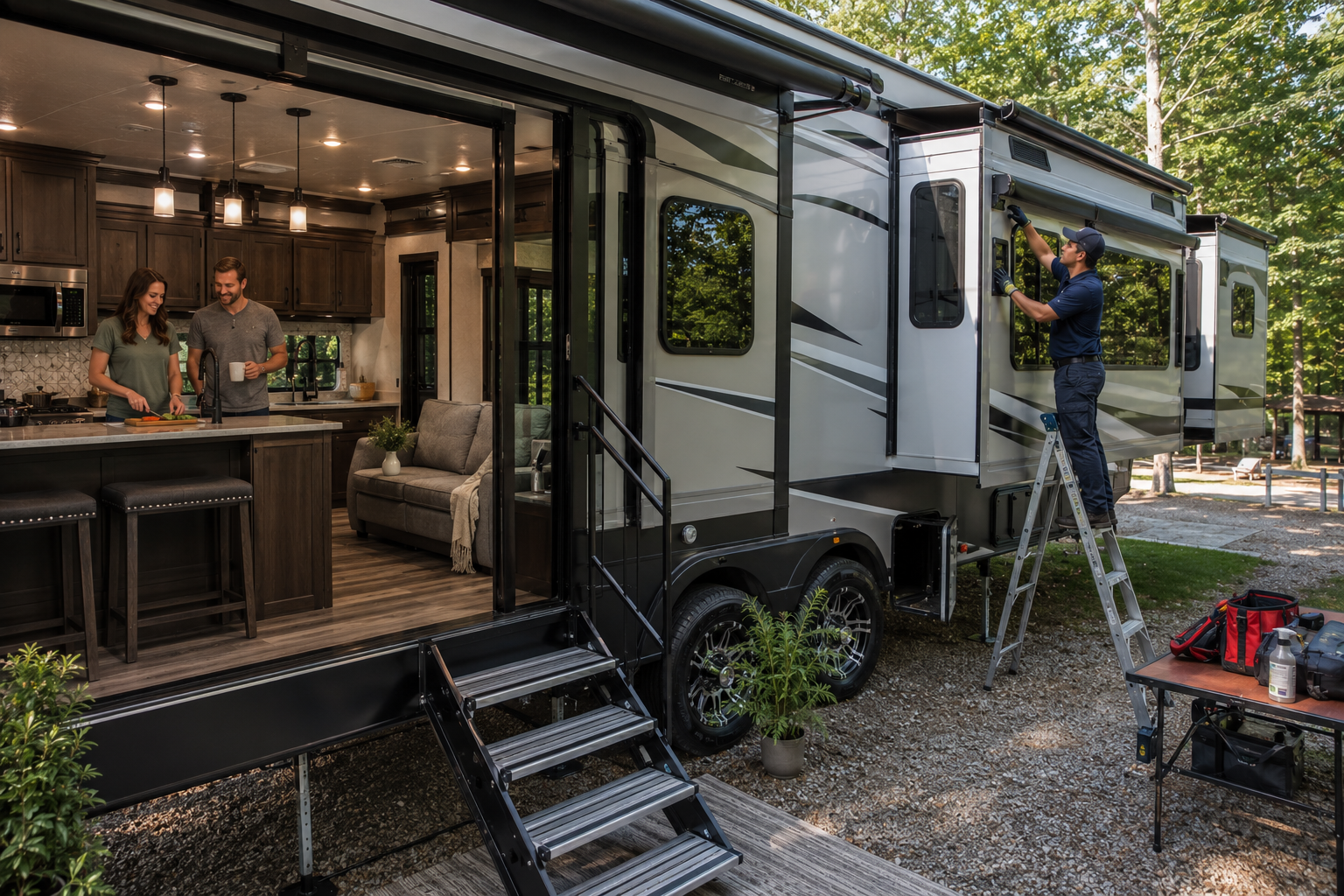
A new RV may require fewer age-related repairs initially, but owners still need to inspect seals, tires, brakes, wheel bearings, batteries, appliances, and slide-outs.
A used RV may require more immediate maintenance depending on age and how the previous owner cared for it.
When comparing prices, consider what the used fifth wheel might need soon.
If one unit is $8,000 cheaper but immediately needs tires, batteries, roof work, brakes, and an appliance repair, part of that savings disappears quickly.
This is why condition is more important than model year alone.
Which Has Better Resale Value?
Resale depends on much more than whether the fifth wheel was originally purchased new or used.
Important factors include:
Brand
Model
Condition
Maintenance history
Age
Floorplan popularity
Market demand
Upgrades
Exterior condition
Water damage history
Premium fifth wheels that are maintained carefully may hold buyer interest better than poorly maintained entry-level models.
Keeping service records and addressing leaks immediately can have a major effect on future resale confidence.
So, Which Is the Smarter Buy?
A new fifth wheel is usually the smarter buy if you prioritize warranty coverage, the newest features, a clean ownership history, and the ability to choose from current floorplans.
A used fifth wheel is often the smarter buy if your priority is maximizing value, reducing the initial purchase price, or getting into a higher-end RV for your budget.
The best used fifth wheel is not simply the cheapest one.
It is a well-maintained unit with a floorplan you like, a condition you can verify, and a price that leaves room in your budget for ownership expenses.
Likewise, the best new fifth wheel is not necessarily the most expensive model.
It is the one you can comfortably afford, safely tow, and realistically use.
Final Verdict: New or Used Fifth Wheel?
For buyers who want the lowest uncertainty and the latest features, buying new can be worth paying more.
For shoppers who care most about value, a carefully inspected used fifth wheel can be the smarter financial purchase.
A&L RV Sales currently carries 239 fifth wheels, including 37 used models, giving buyers a substantial selection for side-by-side comparison across brands, floorplans, weights, model years, and budgets.
Before choosing, compare the actual RVs rather than deciding based only on "new" or "used."
Walk through the floorplan. Inspect the condition. Check the towing numbers. Review financing and warranty terms. Then choose the fifth wheel that makes sense for the way you intend to camp.
Frequently Asked Questions
Is It Better to Buy a Fifth Wheel New or Used?
Neither is always better. New fifth wheels offer current features and more predictable condition, while used fifth wheels usually offer a lower purchase price and may provide more RV for the same budget.
How Old of a Fifth Wheel Should I Buy?
There is no universal ideal age. Condition, maintenance history, water intrusion, tires, roof condition, appliances, and structural integrity matter more than age alone.
A well-maintained older fifth wheel can be a better purchase than a newer neglected unit.
Do Used Fifth Wheels Come With a Warranty?
Some do.
Coverage depends on the dealer and individual RV. A&L currently identifies many used fifth wheels with a 90-day limited warranty, while qualifying units may have other available coverage.
Do New Fifth Wheels Depreciate?
Yes. Like other recreational vehicles, new fifth wheels generally lose value over time. The amount varies by brand, model, condition, demand, and broader market conditions.
Are Used Fifth Wheels Harder to Finance?
Not necessarily. Financing availability depends on factors including RV age, price, credit, lender guidelines, down payment, and loan term.
What Is the Biggest Risk When Buying a Used Fifth Wheel?
Hidden water damage is one of the biggest concerns. A&L's used-RV inspection guide recommends checking carefully for soft flooring, odors, staining, roof or seal issues, and exterior signs of water intrusion.