

Travel Trailer vs. Fifth Wheel: Which One Actually Fits Your Family?
Choosing between a travel trailer and a fifth wheel is one of the first — and most important — decisions a family makes before buying an RV. Both are excellent options. But they serve different travel styles, different budgets, and different tow vehicles. Get this choice wrong, and you'll feel it on every trip.
Here's everything your family needs to know to make the right call.
The Core Difference: How They Hitch
Before you compare floorplans and features, understand how these two RV types connect to your vehicle — because that single difference shapes everything else.
A travel trailer (also called a bumper pull) uses a standard ball hitch mounted to the rear of your tow vehicle. Almost any properly equipped truck, SUV, or even some larger crossovers can pull one. The connection point sits behind the rear axle, which gives the trailer more swing during turns and backing maneuvers.
A fifth wheel uses a specialized kingpin-and-plate hitch mounted inside the bed of a pickup truck. The connection sits over — or just in front of — the truck's rear axle, which dramatically improves highway stability and makes backing into campsites noticeably smoother. The tradeoff: you need a dedicated fifth-wheel hitch in a pickup truck bed, and you lose some of that everyday truck bed utility.
Size, Space & Family Comfort
This is where fifth wheels pull decisively ahead for growing families.
Fifth Wheels: Built Like a Home
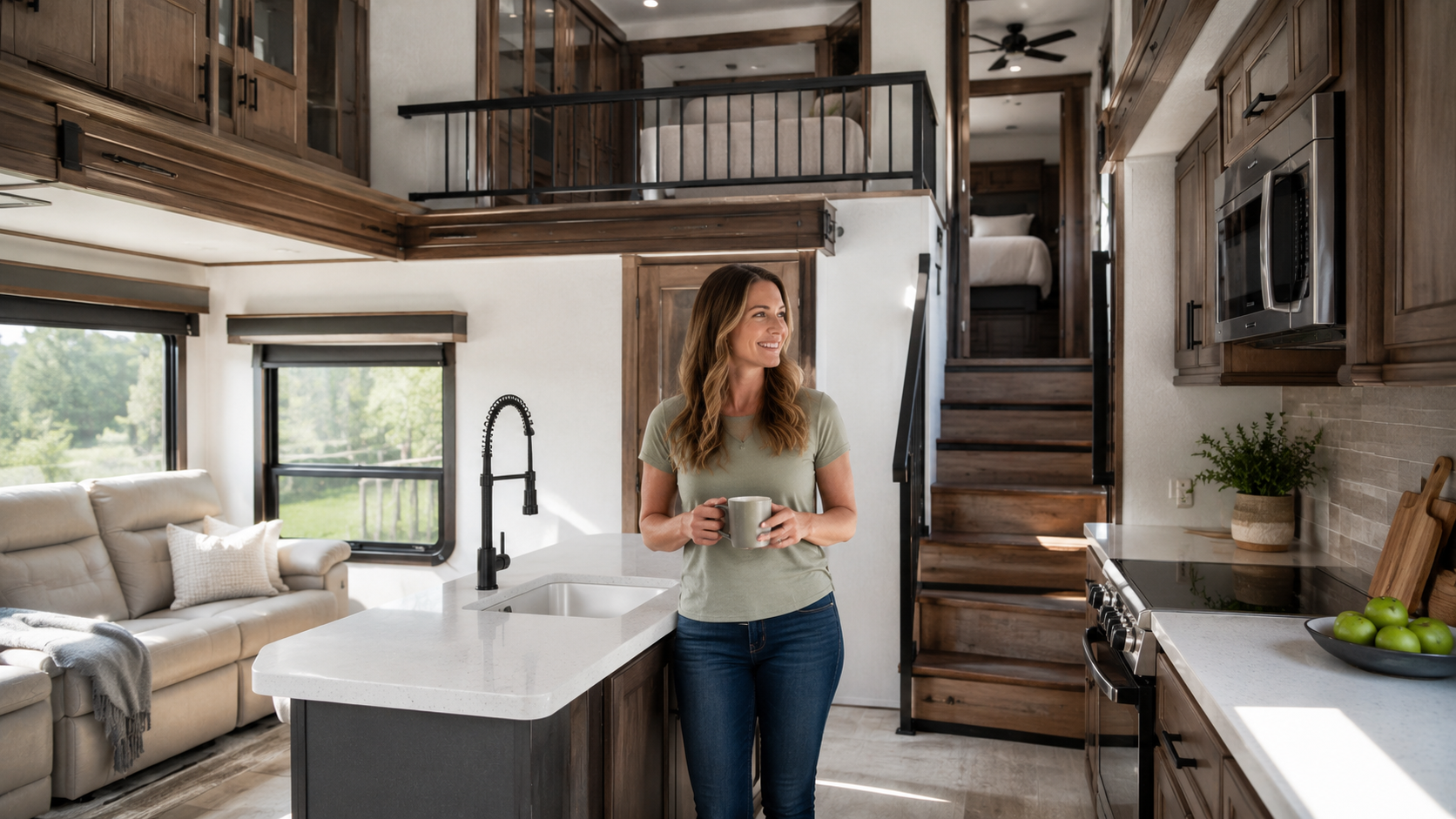
Fifth wheels range from 25 to 45 feet in length and typically stand 12 to 14 feet tall. The gooseneck overhang above the hitch creates a raised front section — usually the master bedroom — giving you a natural split-level layout. That means parents get a private retreat up front while kids sleep in a bunkhouse at the rear. Many fifth wheel models feature:
Separate master bedroom with a door
Dedicated bunk room with multiple full-size or twin bunks
Full residential kitchen with island
Living area with slide-outs on multiple walls
Basement storage compartments
For families who RV frequently or full-time, this multi-room layout is transformative. Bedtime stops being a negotiation when everyone has their own defined space.
Travel Trailers: Surprisingly Spacious for Their Size
Travel trailers range from 12 to 35 feet in length and weigh between 3,000 and 12,000 lbs — a much wider range than most buyers expect. Bunkhouse travel trailers are specifically designed with families in mind, offering dedicated bunk areas, dinettes that convert to sleeping surfaces, and layouts that comfortably sleep six to ten people.
The living spaces are more compact than a fifth wheel of the same price, but for families doing weekend trips or week-long vacations, a well-chosen bunkhouse travel trailer delivers excellent value for every square foot.
Tow Vehicle Requirements
Your current vehicle — or the vehicle you're willing to buy — may decide this question for you.
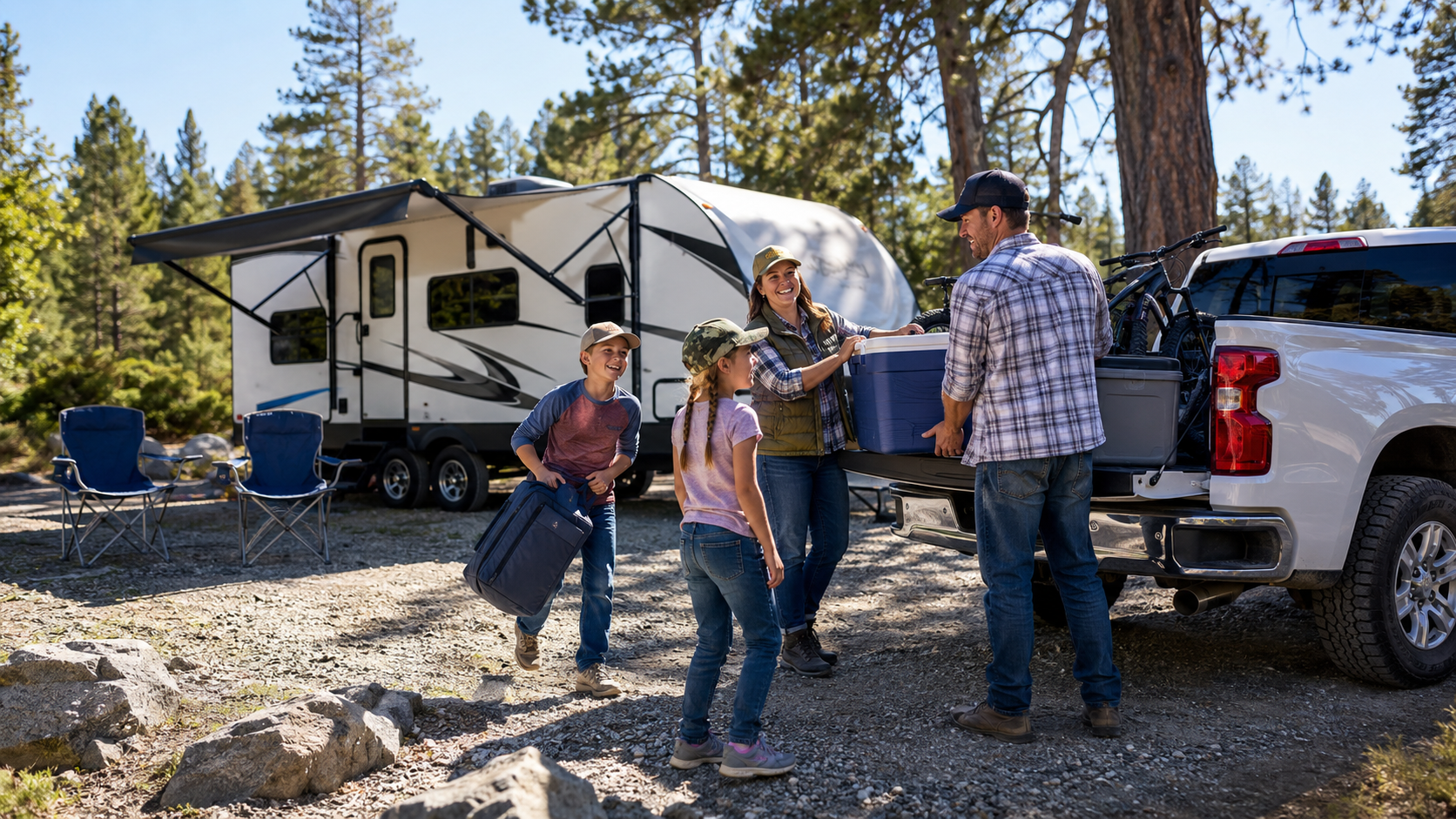
Travel trailer: Can be towed by a wide variety of vehicles. A half-ton truck like the Ford F-150, Ram 1500, or Chevy Silverado 1500 handles most travel trailers in the 3,000–7,000 lb range comfortably. Even some larger SUVs can manage lighter models.
Fifth wheel: Requires a pickup truck — typically a ¾-ton (like a Ram 2500 or Ford F-250) or 1-ton for heavier models. While high-spec half-ton trucks can pull smaller fifth wheels, most families shopping in the 30–40 foot range will need a heavy-duty truck.
If you already own a half-ton truck and don't plan to upgrade, a travel trailer is your natural starting point. If you're buying both a truck and a trailer together, a heavy-duty truck paired with a fifth wheel is often the better long-term investment for family camping comfort.
Towing Experience on the Road
Ask any experienced RV family what they notice most after switching from a travel trailer to a fifth wheel, and most will say the same thing: it drives completely differently.
Because the fifth wheel's hitch sits over the rear axle, the trailer tracks closely behind the truck with minimal sway. Lane changes feel confident, crosswinds are easier to manage, and backing into tight campsites becomes intuitive — you simply look out the rear window and steer.
Travel trailers, by contrast, have a pivot point several feet behind the rear axle. This creates more pronounced swing during turns and backing and requires more practice to master. A weight distribution hitch and sway control bar help considerably, but there's a learning curve — especially with longer trailers above 28 feet.
For families new to towing, a well-equipped travel trailer under 28 feet is very manageable. For seasoned campers who want maximum confidence on long interstate hauls, the fifth wheel towing experience is genuinely superior.
Cost: Upfront and Long-Term
Budget is a real factor, and the numbers are worth laying out clearly.
Travel Trailers:
Generally more affordable than fifth wheels of comparable size
Lower entry price means more inventory options at any given budget
No truck bed loss — your truck remains fully usable between trips
Lighter weight typically means better fuel economy while towing
Fifth Wheels:
Higher upfront cost due to taller build, more materials, and larger footprint
Require a fifth-wheel-specific hitch installation — an additional one-time cost
Larger interiors, more features, and better long-term livability tend to justify the premium for frequent campers
Truck bed is occupied by the hitch, reducing everyday utility
The honest summary: if your family camps two to four times per year on shorter trips, a travel trailer likely delivers better value. If you camp most weekends, take extended summer trips, or are considering full-time RV living, the fifth wheel pays for itself in comfort and livability.
Which One Is Right for Your Family?
Use these questions to point yourself in the right direction.
Choose a Travel Trailer if:
You already own a half-ton truck or SUV
You prioritize flexibility and lower cost
Your trips are mostly weekend getaways or one-week vacations
You want the easiest possible towing learning curve
Smaller footprint matters — easier to store and park at home
Choose a Fifth Wheel if:
You own or plan to buy a ¾-ton or 1-ton pickup
Your family needs genuine privacy — separate sleeping zones for adults and kids
You take long trips, extended summer vacations, or plan to full-time
Residential comfort and kitchen features are a priority
You want the most stable, confidence-inspiring towing experience on the highway
See Both Side-by-Side at A&L RV Sales
The best way to make this decision? Walk through both types in person.
At A&L RV Sales, we carry a deep inventory of travel trailers and fifth wheels across our eight locations in Tennessee, Georgia, Virginia, and North Carolina — including lightweight bunkhouse travel trailers and spacious family fifth wheels from Forest River, Grand Design, Alliance, and more.
Our team can help you match your tow vehicle, your family size, and your travel style to the right RV — no pressure, no guesswork. Browse our travel trailer and fifth wheel inventory today, or stop by any of our locations for a real walkthrough with an RV expert who knows the product inside and out.