
What Is a Toy Hauler and What Can You Haul In It?
A toy hauler is the only RV category built around a genuine contradiction: it's part camper, part garage, and somehow makes both halves work without feeling like a compromise. If you've been eyeing one but aren't sure what actually fits inside, or whether it's overkill for your setup, here's exactly how these rigs work and what they're realistically built to carry.
How a Toy Hauler Is Actually Built
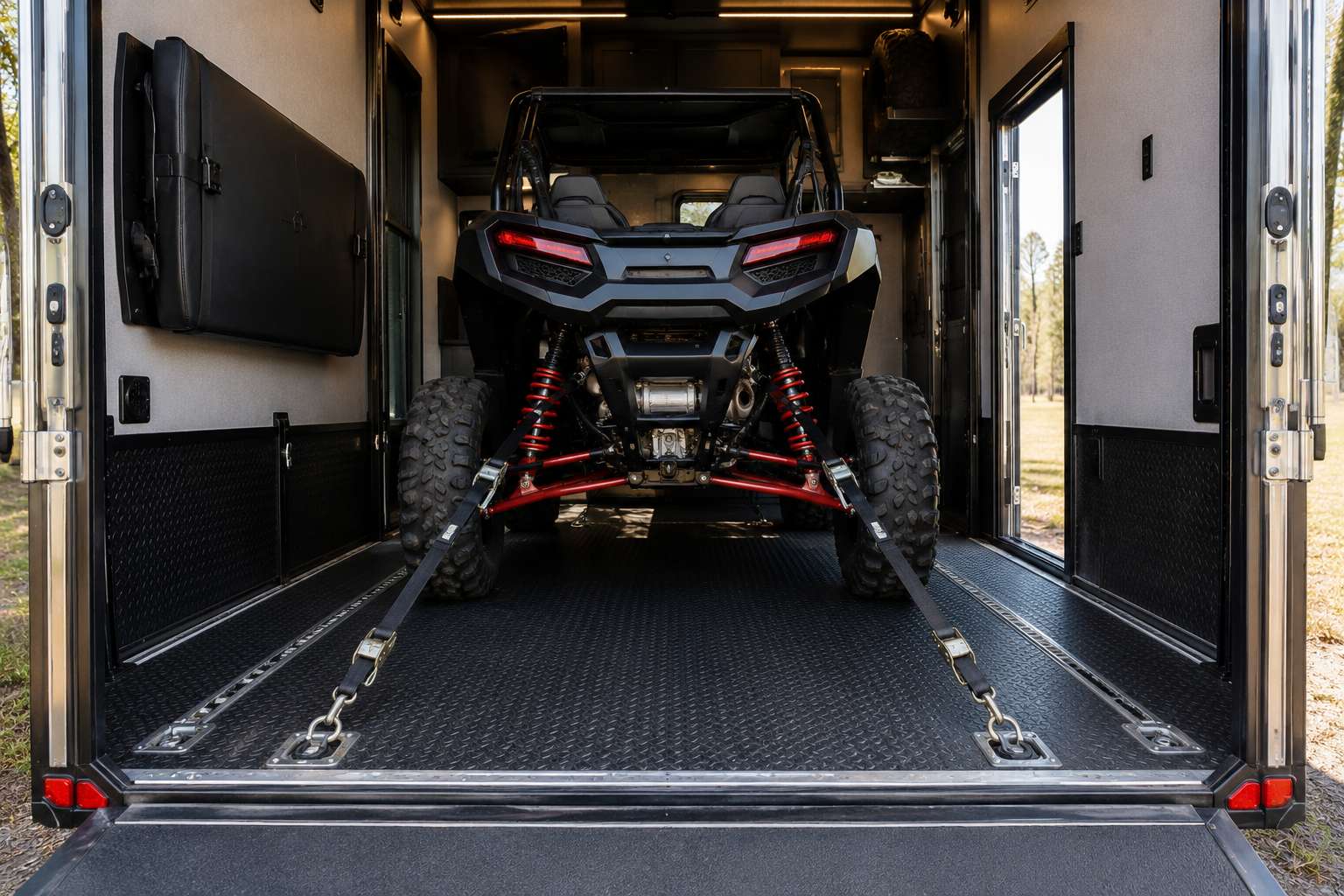
The defining feature of any toy hauler is the rear ramp door, a reinforced wall panel that folds down to create a drivable loading ramp straight into the garage space. Once inside, that garage typically has reinforced flooring, multiple tie-down points, and often built-in fuel stations or extra 12-volt outlets specifically for charging or fueling recreational vehicles.
Toy haulers come in nearly every RV category, including travel trailers, fifth wheels, and even motorized Class A and Class C units, so the "toy hauler" designation describes a floorplan feature rather than a standalone RV class. That garage space typically ranges from as small as 8 feet up to 20 feet in length, and it doubles as flexible living space when you're not actively hauling anything.
What You Can Actually Haul Inside
The garage's reinforced floor and higher-than-average axle weight ratings set toy haulers apart from standard RVs that were never designed to carry heavy cargo.
ATVs and side-by-sides — the most common cargo, with most units weighing well under 1,500 pounds
Motorcycles and dirt bikes — easily fit multiple units depending on garage length
Golf carts — increasingly popular for campground and resort use
Kayaks, bicycles, and skis — smaller gear that fits without needing the full ramp capacity
Small lightweight vehicles — some larger toy haulers can carry compact cars under the weight limit, though this depends heavily on the specific model's rated capacity
Calculating How Much Weight You Can Actually Carry
To find your toy hauler's real cargo capacity, subtract its unloaded vehicle weight, or dry weight, from its gross vehicle weight rating. That difference accounts for passengers, cargo, and anything you plan to load into the garage, and it's a far more accurate number than relying on dry weight alone.
Average toy haulers carry somewhere around 1,500 to 6,000 pounds of cargo capacity, though larger 40-foot models can handle up to 12,000 pounds in some cases. Since most ATVs weigh under 1,000 pounds fully fueled, and many side-by-sides fall in a similar range, the vast majority of typical "toys" fit comfortably within even a mid-size toy hauler's rated capacity.
The Garage Doubles as Living Space Too
Plenty of toy hauler owners never actually load a vehicle into the garage at all, using that open space instead for extra sleeping capacity, a home gym, a workshop, or simply overflow storage for camping gear. The fold-down ramp door also works as an open-air patio in many floorplans, extending outdoor living space directly off the back of the unit when it's parked and not hauling anything.
This dual-purpose flexibility is part of why toy hauler travel trailers and fifth wheels have grown in popularity beyond just the off-road crowd, appealing to larger families who simply want the extra square footage the garage design provides.
Toy Hauler vs. Standard RV: Key Differences
A standard travel trailer or fifth wheel isn't built to handle heavy, shifting cargo the way a toy hauler is, since its floor and axles are rated for typical furniture and passenger weight rather than a loaded ATV. Toy haulers also tend to run heavier overall due to reinforced construction, which matters when matching the unit to an appropriately rated tow vehicle.
Living space in a toy hauler is often more compact than a comparably sized standard trailer, since a meaningful chunk of the floorplan is dedicated to the garage rather than additional bedroom or storage space. Families choosing between the two should weigh how often they'll actually use the garage for hauling versus how much they'd rather have that square footage back for living space.
Who Actually Needs a Toy Hauler
Off-road enthusiasts hauling ATVs or dirt bikes to trailheads are the most obvious fit, since the garage eliminates the need for a separate trailer just for the vehicles. Families with teenagers who ride dirt bikes or drive golf carts at the campground also gravitate toward toy haulers, since it consolidates transportation for both the camper and the recreational gear into a single tow.
Buyers who simply want extra flexible square footage, without ever loading a vehicle inside, are a growing segment too, using the garage as a den, bunk room, or gear-storage area instead.
Questions to Ask Before Buying a Toy Hauler
Ask for the exact garage length and width, since a few extra feet can be the difference between fitting two side-by-sides or only one. Confirm the garage's rated floor weight capacity separately from the unit's overall GVWR, since some garages have lower localized weight limits than the trailer's total rating suggests.
Ask whether the model includes built-in tie-downs, a fuel station, or reinforced flooring as standard features, since these add-ons vary significantly between base and upgraded toy hauler trims.
A toy hauler isn't just a trailer with a garage bolted on, it's purpose-built from the frame up to handle real cargo weight while still delivering a functional living space, which is exactly why it's become the go-to choice for anyone trying to bring both their camper and their toys in a single tow.