
Are Fifth Wheels Harder to Tow Than Travel Trailers?
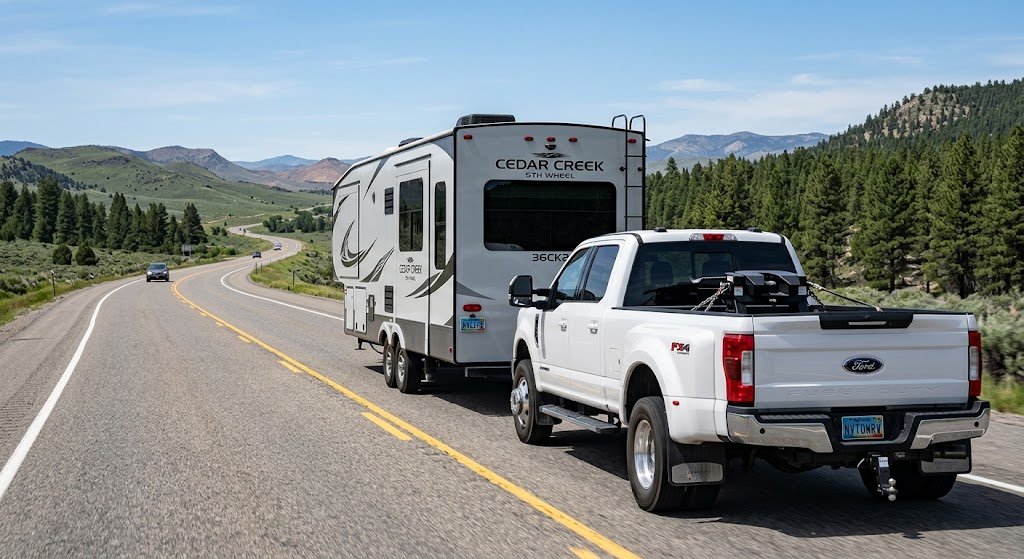
Fifth wheels are generally easier to tow than travel trailers of similar length, despite being larger overall. The kingpin hitch connection sits over the truck's rear axle, which improves stability, reduces sway, and makes backing up more predictable. Travel trailers use a bumper-pull hitch, which can feel less stable at highway speeds and usually needs a weight distribution hitch to tow safely. Both require the right tow vehicle and correct weight matching.
Here's why the towing experience differs so much between the two, and what actually matters when you're deciding between a fifth wheel and a travel trailer.
Why Do Fifth Wheels Feel More Stable to Tow?
A fifth wheel's hitch point sits on a raised platform in the truck bed, positioned over or just ahead of the rear axle. That pivot point sits higher and further forward than a bumper-pull connection, which puts more of the trailer's weight directly over the truck's strongest support point instead of hanging off the back bumper.
This setup lowers the trailer's effective center of gravity relative to the tow vehicle and shortens the effective lever arm that causes sway. The result is a rig that tracks straighter, responds to steering inputs more predictably, and feels less affected by wind gusts or passing semis than a similarly sized travel trailer.
Fifth wheels also don't require a separate weight distribution hitch the way most travel trailers do, since the kingpin connection already handles weight transfer differently. That's one less system to set up and maintain correctly.
Why Do Travel Trailers Feel Different on the Road?
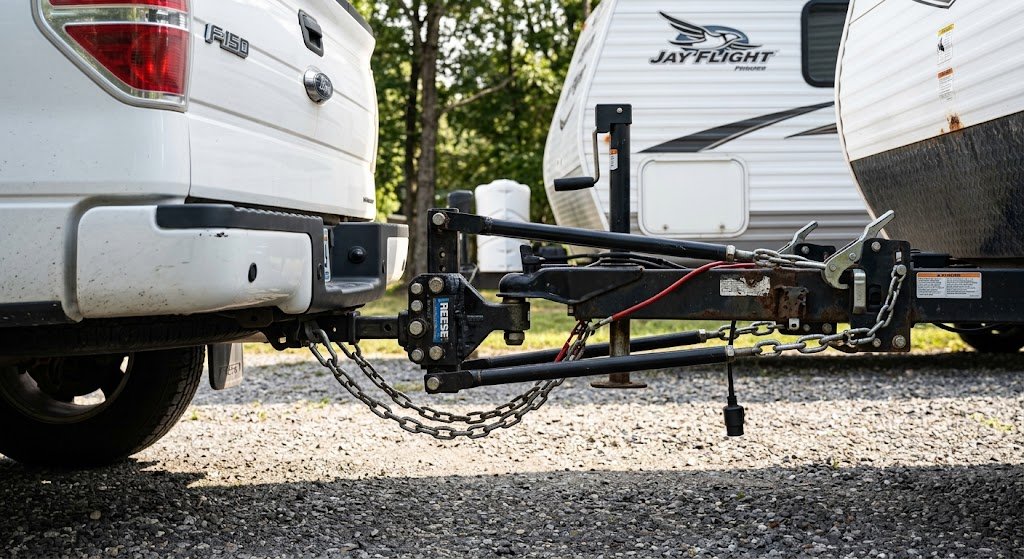
A travel trailer connects at the rear bumper, with all of its tongue weight pulling down at a single point behind the truck's rear axle. That's a longer lever arm than a fifth wheel's setup, which means more leverage for the trailer to push and pull the tow vehicle around, especially in wind or when a passing truck creates a pressure wave.
This is exactly why a weight distribution hitch matters so much for travel trailers. Without one, tongue weight sits entirely on the rear axle, causing squat, reduced steering control, and more sway sensitivity. With a properly set up weight distribution hitch, a travel trailer tows much more predictably, though it still doesn't have quite the same planted feel as a fifth wheel's over-the-axle connection.
Lighter, shorter travel trailers can still tow very comfortably. Some are specifically built and marketed as easy-to-tow options for exactly this reason, with lower overall weight and tongue weight that stays easy to manage even on a lighter duty tow vehicle.
Which Requires a Bigger Truck: Fifth Wheel or Travel Trailer?
This depends more on the specific trailer's weight than the hitch type alone, but there are some general patterns worth knowing.
Fifth wheels tend to run heavier overall because the raised front cap and kingpin box add weight, and popular floorplans often come with residential-style features that add to the total. Most mid-size to large fifth wheels need at least a three-quarter-ton truck, and larger units often call for a one-ton dually. Our guide on what size truck you need to pull a fifth wheel breaks this down by weight class.
Travel trailers cover a much wider weight range, from small, light units under 3,500 pounds up to large bunkhouse models that rival fifth wheels in weight. Whether a half-ton truck can tow a specific travel trailer depends entirely on that trailer's actual loaded weight, not on trailer type alone.
Either way, the right move is checking your tow vehicle's real capacity against the trailer's numbers rather than assuming based on category. Our tow guides and our breakdown of how to find your truck's real towing capacity both walk through this in detail, and our RV towing weight capacity guide covers the GVWR and GCWR numbers that actually matter.
Is Backing Up Easier with a Fifth Wheel or a Travel Trailer?
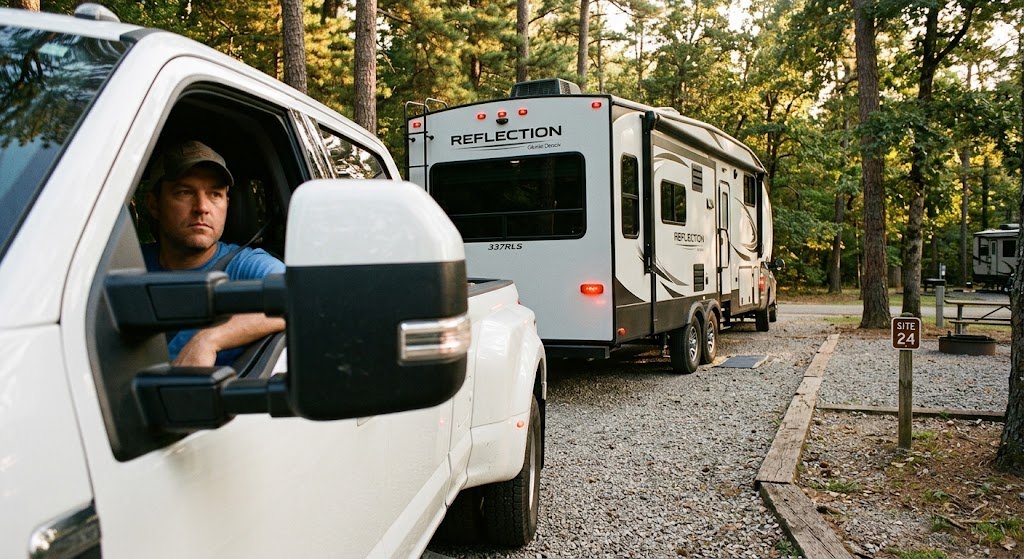
Most experienced owners find fifth wheels easier to back up. The shorter distance between the hitch pivot point and the trailer's axles means the trailer responds faster to small steering corrections, which gives the driver quicker feedback when backing into a campsite or driveway.
Travel trailers have a longer effective wheelbase between the hitch ball and the trailer axles, which means backing up takes larger, more deliberate steering inputs and a bit more practice to get a feel for. It's not difficult once you've done it a few times, but the learning curve is generally a little steeper than with a fifth wheel.
What About Sway, Wind, and Passing Trucks?
Fifth wheels are less prone to sway because of that higher, more forward pivot point sitting over the rear axle. Crosswinds and passing truck turbulence still affect a fifth wheel, but the shorter lever arm gives the trailer less leverage to push the tow vehicle around.
Travel trailers are more sensitive to sway, which is why weight distribution hitches with integrated sway control are so common on mid-size and larger units. Loading matters too. Too much weight behind the trailer's axles, or too little tongue weight relative to total trailer weight, makes sway worse on a travel trailer far more noticeably than it does on a fifth wheel.
Which Is Easier for First-Time Tow Vehicle Owners?
For drivers new to towing, fifth wheels often feel more forgiving on the highway thanks to that stable, over-the-axle connection. The tradeoff is that fifth wheels require a truck bed and a raised hitch platform, which rules out SUVs and most half-ton setups for anything beyond smaller units.
Travel trailers offer more flexibility in tow vehicle choice, including SUVs and half-ton trucks for lighter models, but they ask a little more of the driver in terms of setting up the weight distribution hitch correctly and getting comfortable with sway management.
Neither is objectively harder once you're set up correctly and matched to the right tow vehicle. The bigger factor is usually whether your truck and trailer choice fit each other in the first place. Our post on which RV type is right for you is a good starting point if you're still weighing trailer types against your lifestyle and towing comfort level.
What Should You Consider Before Choosing Between the Two?
Your current tow vehicle. If you already own a half-ton truck or SUV, that may steer you toward a lighter travel trailer rather than most fifth wheels.
How often you'll be backing into tight spots. Frequent boondocking or tight campground sites may make a fifth wheel's easier backing feel worth the tradeoff in tow vehicle requirements.
Long-term plans. If full-time living is on the table, the extra stability and interior space of a fifth wheel is worth factoring in early.
New vs. used considerations. Weight and hitch requirements can vary significantly between model years, so it's worth checking our guide on new vs used fifth wheels if you're shopping the used market.
Budget for the hitch setup. Fifth wheel hitches and travel trailer weight distribution hitches both add cost on top of the trailer itself, and it's worth pricing that in before you commit.
Common Mistakes When Comparing Towing Difficulty
Judging difficulty by trailer length alone. A 32-foot fifth wheel and a 32-foot travel trailer don't tow the same way, since the hitch type and pivot point matter more than overall length.
Assuming any half-ton truck can handle any fifth wheel. Most fifth wheels need at least a three-quarter-ton truck once you're above smaller, lighter floorplans.
Skipping the weight distribution hitch on a travel trailer. Some owners assume towing feels unstable because travel trailers are inherently harder to tow, when the real issue is a missing or poorly adjusted weight distribution hitch.
Not test driving loaded. Towing capacity numbers only tell part of the story. A short test tow with the trailer loaded the way you'd actually use it reveals a lot about how it really feels behind your specific truck.
How A&L RV Sales Can Help You Choose
If you're trying to decide between a fifth wheel and a travel trailer, the right answer usually comes down to your tow vehicle, how you plan to use the RV, and how much towing experience you already have. Our team can walk through both options against your specific truck's capacity before you buy.
Browse our fifth wheel inventory or travel trailer inventory to compare weights and floorplans, check our tow guides to confirm what your vehicle can handle, or reach out about financing and trade-in options if you're upgrading from a trailer that's outgrown your comfort level.
Frequently Asked Questions
Do fifth wheels tow better than travel trailers?
Most owners find fifth wheels tow more predictably thanks to the over-the-axle hitch connection, which reduces sway and improves stability. Travel trailers can tow very well too, especially lighter models, but they rely more heavily on a correctly set up weight distribution hitch to achieve similar stability.
Can a half-ton truck tow a fifth wheel?
Only smaller, lighter fifth wheels fall within most half-ton trucks' capacity, and even then it depends on the specific truck's payload and towing ratings. Most mid-size and larger fifth wheels require at least a three-quarter-ton truck to tow safely.
Do fifth wheels sway less than travel trailers?
Yes, generally. The kingpin hitch's position over the rear axle shortens the lever arm that causes sway, making fifth wheels less sensitive to wind and passing traffic than a similarly sized travel trailer on a bumper-pull hitch.
Is it harder to back up a fifth wheel or a travel trailer?
Travel trailers are usually a bit harder to back up because of the longer distance between the hitch ball and the trailer's axles, which requires larger steering corrections. Fifth wheels respond more quickly to small steering inputs, which many drivers find easier to manage.
Do fifth wheels need a special hitch to tow?
Yes, fifth wheels require a fifth wheel hitch mounted in the truck bed, which is a different system than the weight distribution hitch used for most travel trailers. The two hitch types aren't interchangeable without an adapter.
What size truck do I need for a fifth wheel vs a travel trailer?
Most fifth wheels need at least a three-quarter-ton truck, with larger units requiring a one-ton dually. Travel trailers range more widely, with lighter models towable by a well-equipped half-ton truck and heavier bunkhouse models needing a heavier duty tow vehicle.
Are fifth wheels safer to tow at highway speeds?
Fifth wheels generally feel more stable at highway speeds due to their hitch position and reduced sway tendency. Travel trailers can tow safely at highway speeds too, provided they're matched to the right tow vehicle and equipped with a properly adjusted weight distribution hitch.
Final Takeaway
Fifth wheels tend to tow more predictably than travel trailers because of where the hitch connects to the truck, not because travel trailers are inherently difficult. Both can tow safely and comfortably when they're matched to the right tow vehicle and set up correctly. The real question isn't which is harder, it's which setup fits your truck, your experience level, and how you plan to use the RV.
If you're weighing a fifth wheel against a travel trailer, our team at A&L RV Sales can help you compare both against your tow vehicle and find the right fit.